
TL;DR:
- Effective digital transformation depends on strategy, leadership, and governance, not just technology.
- Appointing a senior digital lead and establishing annual review cycles are key to sustainability.
- Measuring impact through clear metrics and continuous review ensures lasting operational gains.
Many UK schools have invested heavily in digital tools over the past decade, yet a surprising number still struggle with the same operational bottlenecks they faced before. Fragmented communication, administrative overload, and inconsistent systems persist even when technology is in place. The reason is rarely the technology itself. It is the strategy, leadership, and implementation behind it. This guide is designed to help school administrators and headteachers move beyond simply adopting digital solutions, and instead build an operational framework that genuinely transforms how your school runs day to day.
Table of Contents
- Understanding operational challenges in UK schools
- Building a strong foundation: Governance and digital leadership
- Selecting and integrating digital tools for high impact
- Embedding efficiency: Measuring, improving and sustaining gains
- Why school efficiency is not just about the latest tech
- How eSchools supports operational efficiency in UK schools
- Frequently asked questions
Key Takeaways
| Point | Details |
|---|---|
| Governance matters most | Strategic leadership and digital governance are the key drivers of lasting efficiency in schools. |
| Pilot before rolling out | Testing digital tools in small groups helps reduce adoption risks and improves results. |
| Measure what counts | Focus on outcomes like admin workload, engagement, and cost savings to track real impact. |
| Continuous review is vital | Annual reviews and regular feedback cycles ensure digital strategies remain effective and sustainable. |
Understanding operational challenges in UK schools
Before any meaningful change is possible, you need to be honest about where your school is losing time and resource. For most UK schools, the challenges cluster around three core areas: fragmented communication between staff, parents, and governors; paperwork bottlenecks that slow down decision making; and inconsistent systems where different departments use incompatible tools that do not talk to each other.
These problems are not trivial. A school that cannot communicate efficiently wastes staff time, frustrates parents, and creates governance risks. When different year groups use different platforms for recording attendance, sharing homework, or logging incidents, data becomes unreliable and reporting becomes a significant burden.
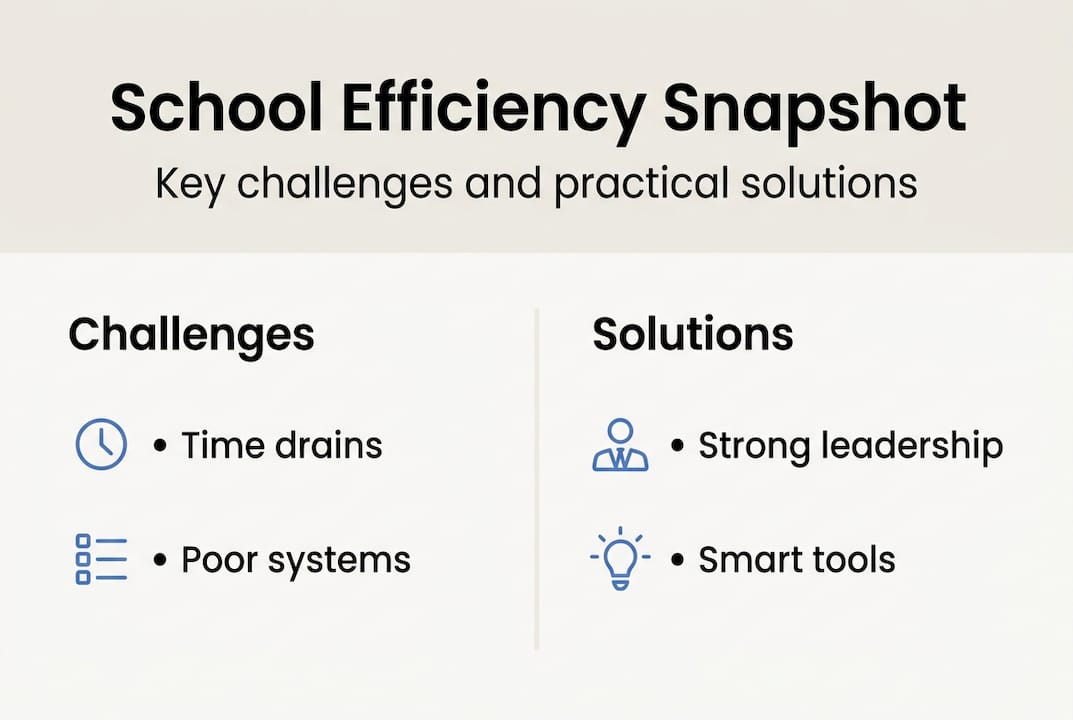
The pressure from Ofsted and governance bodies also plays a significant role. While DfE school compliance standards are not always legally mandatory, they carry considerable weight during inspections and in governor scrutiny. As the government guidance on meeting digital standards makes clear, focusing on governance, including appointing a senior digital lead and conducting annual reviews, is the factor that unlocks wider efficiency gains across all other areas.
The most common operational pain points reported by administrators include:
- Time constraints: Admin teams spend an average of several hours per week on tasks that could be automated or streamlined.
- Resource allocation: Budgets are stretched, making it harder to justify investment in new systems without clear evidence of return.
- Digital expectations: Parents, students, and staff all expect fast, accessible digital communication, yet many schools still rely on paper letters and phone calls.
“Technology should reduce administrative burden, not add to it. When tools are not properly integrated or supported, they become another item on an already full to-do list.”
Research consistently shows that only a minority of digital investments yield the long-term efficiencies originally promised. The gap between expectation and outcome is rarely about the tool. It is almost always about the plan surrounding it. You can explore how the DFE tracker can help you benchmark your school’s current digital standing before taking the next step.
Building a strong foundation: Governance and digital leadership
Once you understand where the problems lie, the next question is who should be driving the solutions. The answer, consistently backed by evidence, is clear: strong governance and senior digital leadership are the bedrock of sustainable operational improvement.
The DfE guidance on digital standards is explicit that appointing a senior digital lead and embedding annual reviews into governance cycles is what unlocks lasting gains across every other area of school operations. Without this foundation, individual tools remain isolated, staff adoption remains patchy, and efficiency gains plateau quickly.
Here is a practical step-by-step approach to building your digital governance structure:
- Appoint a senior digital lead: This should be a member of your Senior Leadership Team (SLT) with both the authority and the time to drive digital strategy across the school.
- Define the scope of the role: The digital lead should be responsible for overseeing tool selection, training, adoption monitoring, and annual reporting to governors.
- Establish a digital governance group: Include representatives from teaching staff, administration, IT, and if possible, parent governors. Diverse input improves decisions.
- Set annual review cycles: Schedule formal reviews of all digital systems and their impact. Use this to identify what is working, what is not, and what should be changed or replaced.
- Create a two-year digital roadmap: Avoid making reactive decisions. A planned roadmap helps you budget properly and sequence changes so they do not overwhelm staff.
| Governance element | Purpose | Review frequency |
|---|---|---|
| Senior digital lead | Strategic oversight and accountability | Ongoing |
| Annual digital audit | Review of all systems and their impact | Yearly |
| Staff digital feedback | Identify adoption barriers and training gaps | Termly |
| Governor digital report | Assurance and strategic approval | Twice yearly |
Pro Tip: Before rolling out any new tool school-wide, pilot it with one year group or department for a half-term. This reduces the risk of poor adoption and gives you real data to share with governors and sceptical staff members.
A well-planned digital engagement strategy built around governance will deliver far more consistent results than any single platform purchased without a framework. For more detail on how to approach this process, the practical guide to integrating technology in schools is a strong starting point.
Selecting and integrating digital tools for high impact
With governance structures in place, you are in a far stronger position to make good decisions about which tools to adopt. The market for edtech is vast, and the risk of choosing the wrong solution is real. Poor selection wastes budget, demoralises staff, and erodes trust in future digital initiatives.
When evaluating any digital tool, assess it against four core criteria:
- Usability: Can your least tech-confident staff member use it without significant training? If not, adoption will be a persistent problem.
- Integration: Does it connect with the systems you already use, such as your management information system (MIS) or existing communication platform?
- Support: What does the provider offer in terms of onboarding, ongoing training, and responsive technical support?
- Impact: Does the tool address a specific, measurable operational problem? Can you track its effect over time?
| Tool category | Key benefit | Common pitfall |
|---|---|---|
| School admin platforms | Automates routine admin tasks | Over-complex if not configured properly |
| Communication tools | Speeds up parent and staff messaging | Low engagement if parents are not onboarded |
| Online learning platforms | Supports remote and blended learning | Inconsistent teacher usage reduces impact |
| Parent evening booking | Eliminates scheduling bottlenecks | Requires clear communication at launch |
Practical steps for trialling and rolling out new technology include selecting one operational pain point to address first, identifying a volunteer group of staff willing to test the solution, and gathering structured feedback after four to six weeks. The DfE guidance specifically notes that piloting mitigates risks like poor adoption, which is the leading cause of failed digital investment.

Exploring different digital classroom tools available to UK schools will help you build a clearer picture of what is suitable for your setting. For a broader view, the list of top edtech for schools provides a useful comparative reference across administrative and pedagogical categories.
Pro Tip: Identify two or three enthusiastic staff members as internal champions for each new tool. These champions build peer trust, reduce pressure on IT support, and accelerate wider adoption across the school.
Once a tool passes your pilot stage, a phased rollout is far more effective than a whole-school launch on day one. Give staff time to build confidence and share positive experiences. The right school administration software can reduce administrative workloads significantly, but only when it is embedded properly into daily routines.
Embedding efficiency: Measuring, improving and sustaining gains
Selecting and launching tools is only the beginning. The schools that sustain genuine operational gains are those that build regular measurement and refinement into their culture. This is where most schools fall short. They implement a system, see early improvements, and then stop reviewing its impact until something goes wrong.
To avoid this, you need a clear set of metrics to track from the outset. The most useful measures of operational efficiency in schools include:
- Communication speed: How quickly do messages reach parents and staff? Are responses faster than before?
- Administrative time: Track how many hours per week admin staff spend on specific tasks before and after implementation.
- Engagement rates: For online learning and communication platforms, monitor how many parents and students are actively using the tool each week.
- Cost savings: Calculate time saved and convert this to a cost figure to present a clear return on investment to governors.
- Staff and parent satisfaction: Run termly surveys to capture qualitative feedback alongside your quantitative data.
| Metric | How to measure | Review frequency |
|---|---|---|
| Admin hours saved | Time logging before and after | Half-termly |
| Parent message open rates | Platform analytics dashboard | Monthly |
| Online learning engagement | Login and submission data | Weekly |
| Staff satisfaction score | Anonymous staff survey | Termly |
The DfE standards guidance is clear that annual reviews are central to unlocking further efficiency benefits through good governance. These reviews should not simply confirm that tools are still in use. They should interrogate whether outcomes have improved and whether the right tools are still the right fit for your school’s evolving needs.
Pro Tip: When reviewing digital systems, do not focus only on the technical performance of the platform. Assess the user experience from the perspective of a parent, a newly qualified teacher, and a member of the admin team. This reveals friction points that data alone will not show you.
Maintaining momentum requires a cycle of review, refinement, and scaling. When something works well in one department, document why it worked and replicate the conditions elsewhere. For evidence on how this translates into real educational improvement, the research on digital outcomes in schools provides useful grounding. You should also consider reviewing approaches to improving online learning as part of your annual assessment.
Why school efficiency is not just about the latest tech
Here is an uncomfortable truth that the edtech industry rarely says out loud: the schools that achieve the greatest operational efficiency are not always the ones with the most advanced technology. They are the ones with the clearest strategy and the most committed leadership.
We have seen schools invest in cutting-edge platforms that sit largely unused six months after launch. We have also seen schools achieve remarkable improvements using relatively simple tools, because they invested equally in training, governance, and cultural buy-in. The technology is rarely the limiting factor. The limiting factor is almost always people and process.
The DfE guidance reinforces this point directly. Focusing on governance, particularly establishing a senior digital lead and committing to annual reviews, is what unlocks the broader efficiency gains that schools are seeking. Technology is an enabler. It is not a solution in itself.
Top-performing schools treat digital tools the way an experienced surgeon treats a scalpel. It is a precision instrument, valuable only when wielded with skill and purpose. The digital engagement benefits are real and significant, but they follow from strategic decisions, not from purchases alone. If your school is not seeing the returns you expected from a recent investment, look first at your governance and leadership structure before concluding the tool is at fault.
How eSchools supports operational efficiency in UK schools
Translating strategic insight into practice is much easier with a trusted partner who understands the specific demands of UK school administration. eSchools has spent over 14 years working alongside school leaders, administrators, and MAT teams to design and deliver solutions that genuinely reduce operational burden.

From bespoke school websites and communication platforms to admin software for schools and parent evening booking systems, every eSchools tool is built with usability and impact at its core. Our eSchools case studies demonstrate how schools like yours have moved from fragmented, time-consuming processes to streamlined operations that free up staff to focus on what matters most. If you are ready to explore the right edtech solutions for schools for your setting, the eSchools team is here to guide you every step of the way.
Frequently asked questions
What is the best way to start improving school operational efficiency?
Begin with a clear focus on governance and digital leadership, then pilot digital solutions that address your school’s most pressing operational bottlenecks. As DfE guidance confirms, appointing a senior digital lead and establishing annual review cycles is the foundation that unlocks wider gains.
Are DfE digital standards mandatory for UK schools?
No, but they carry significant weight during Ofsted inspections and in governor scrutiny, making them a highly practical reference point for any school planning its digital strategy. The DfE standards framework is worth treating as a benchmark even where formal compliance is not required.
How can we measure the impact of digital investments in school operations?
Assess outcomes across communication speed, administrative workloads, engagement rates, and overall cost savings, using both platform data and regular feedback from staff and parents. Annual reviews embedded in your governance cycle are essential for tracking progress over time.
What is a common reason digital tools fail to drive efficiency?
Poor adoption and lack of user involvement in planning and piloting phases are the leading causes of failure. Running structured pilots before full rollout significantly reduces this risk and helps build staff confidence and buy-in from the outset.