
TL;DR:
- Effective digital engagement requires strategic planning, assessment, and clear measurement of outcomes.
- Schools should conduct honest audits to identify gaps in connectivity, safeguarding, and staff capability.
- Leadership and ongoing review are key to sustaining meaningful communication and reducing workload.
Ineffective communication and administrative overload are draining time and energy from school leaders across the UK. When parents cannot access timely updates, staff spend hours on manual processes, and governors lack visibility, the entire school community suffers. The good news is that this is a solvable problem. In England, school leaders can structure their overall digital engagement work around DfE guidance and processes that already exist to help you plan effectively. This article maps out a practical, evidence-based approach to building a digital engagement process that genuinely improves communication, reduces workload, and delivers measurable outcomes for your school or trust.
Table of Contents
- Understanding digital engagement in schools
- Preparation: Assessing your school’s digital readiness
- Step-by-step guide: Implementing a school digital engagement process
- Measuring impact and overcoming barriers
- Why most school digital engagement fails (and what actually works)
- Take your school’s engagement to the next level
- Frequently asked questions
Key Takeaways
| Point | Details |
|---|---|
| Systematic foundations | A structured process, starting with a readiness audit, is essential for successful school digital engagement. |
| Plan and phase | Implement digital engagement via phased pilots, training, and measurable objectives tied to school improvement. |
| Address barriers early | Resolve connectivity, security, and staff concerns at the outset to prevent disruption later. |
| Iterate and measure | Continuous feedback and reviewing impact will help you refine your engagement process effectively. |
Understanding digital engagement in schools
Digital engagement in schools is far broader than classroom technology. It spans every touchpoint where digital tools connect your staff, students, parents, and governors. When you think about it systematically, you start to see just how much ground it covers.
Digital use is widespread in England’s schools, covering data management, parental communication, governance, and financial administration. That breadth is precisely why an unplanned approach creates problems. Without structure, schools end up with overlapping tools, inconsistent communication, and no clear way to measure whether any of it is working.
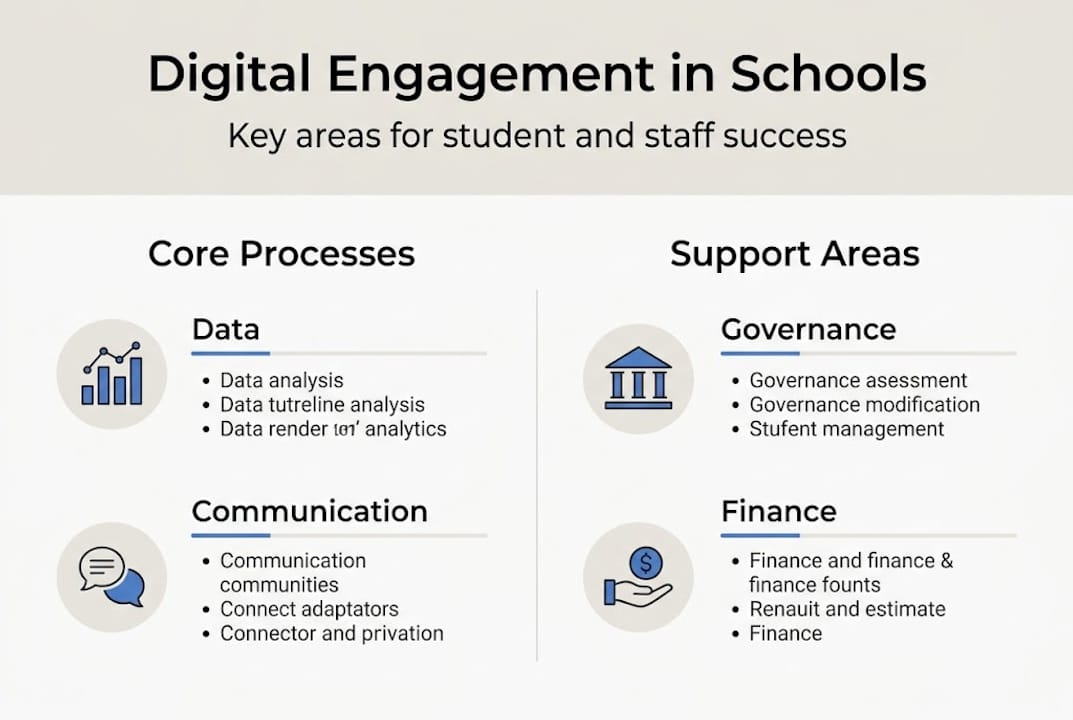
The DfE has responded to this by providing a practical framework. Their technology guidance for schools links digital planning directly to school improvement, encouraging leaders to treat technology as a strategic enabler rather than a collection of purchases. Aligning with DfE technology standards gives your planning a credible foundation and supports Ofsted readiness.
Digital engagement in practice includes:
- Parental communication: newsletters, alerts, parent evening booking, and real-time updates
- Data and administration: attendance tracking, reporting, and MIS integration
- Governance: secure document sharing, minutes, and transparency requirements
- Staff collaboration: shared planning platforms, CPD resources, and internal messaging
- Safeguarding and compliance: data protection, filtering, monitoring, and access controls
The barriers are real. Cost is consistently cited as the biggest obstacle, alongside concerns about safeguarding, device management, and the perception that digital tools add to workload rather than reducing it. The solution is not to avoid technology but to select and implement it strategically.
Key insight: Measuring impact matters as much as the tools themselves. Deploying technology without defined success criteria means you cannot justify investment, improve practice, or demonstrate value to governors and Ofsted.
Your DfE compliance guide is a useful starting point for understanding statutory requirements that shape your digital presence. Once you understand the scope, you can begin preparing properly.
Preparation: Assessing your school’s digital readiness
Before you expand any digital engagement activity, you need an honest baseline. Skipping this step is one of the most common mistakes schools make, and it is costly in both time and resource.
The starting point is a structured audit. This does not need to be lengthy, but it must be honest. Look at what you currently have, what is being used, and what gaps exist. Connectivity and security foundations are critical; if these are weak, engagement will stall regardless of how good your chosen platform is.

A striking reality: only 16% of UK schools currently meet all DfE digital standards, despite high awareness of what those standards require. That gap highlights just how important the readiness stage is before scaling up.
Pro Tip: Use the DfE’s own self-assessment tools alongside your audit. They are free, structured, and directly aligned to the standards your school will be judged against.
Here is a simple framework for your readiness assessment:
| Readiness area | What to assess | Funded support available |
|---|---|---|
| Connectivity | Broadband speed, Wi-Fi coverage, reliability | DfE Connect the Classroom programme |
| Device management | Device ratios, maintenance, accessibility | DfE device allocation schemes |
| Safeguarding and data | Filtering, monitoring, GDPR compliance | DfE online safety tools |
| Staff capability | Digital confidence, training needs | CPD funding streams |
| Communication tools | Current channels, parent reach, engagement rates | Internal review |
Once you have completed your audit, document findings clearly. Note which areas are strong, which need investment, and which represent an urgent risk. This document becomes the foundation of your engagement plan.
Reviewing your online collaboration practices at this stage can also reveal quick wins. Sometimes the infrastructure is adequate but the processes around it need attention. Small changes in how staff share information or communicate with parents can deliver immediate efficiency gains without significant cost.
Step-by-step guide: Implementing a school digital engagement process
With your readiness assessment complete, you are ready to build and launch your process. A staged implementation process that includes audit, measurable objectives, phasing, staff training, and impact review consistently outperforms ad hoc roll-outs in schools.
Here is the process we recommend:
- Audit your current state — Use your readiness assessment findings as the starting point. Know what you have before deciding what you need.
- Define clear objectives — Tie your digital engagement goals directly to school improvement priorities. For example, improving parent communication rates or reducing admin time by a measurable amount.
- Select and pilot tools — Choose platforms that meet your objectives and pilot them with a small group before school-wide roll-out. This surfaces problems early and builds internal advocates.
- Train staff and stakeholders — Invest in support for staff training before launch. Resistance often comes from uncertainty, not unwillingness.
- Communicate with parents and governors — Stakeholders who understand why changes are happening are far more likely to engage positively from the outset.
- Review impact regularly — Set a review cycle of at least once per term. Adjust based on data and feedback, not assumptions.
Pro Tip: Investing in parental engagement tools that are intuitive for families increases adoption rates significantly. The best platform in the world will not work if parents do not use it.
Choosing between a phased approach and an all-at-once roll-out is a genuine decision that depends on your school’s capacity:
| Approach | Advantages | Risks |
|---|---|---|
| Phased roll-out | Lower risk, easier to manage, builds confidence | Slower results, may create inconsistency temporarily |
| All-at-once | Faster impact, consistent messaging | Higher pressure on staff, harder to troubleshoot |
For most schools, a phased approach is more sustainable and produces better long-term outcomes. Move at a pace your staff and community can genuinely absorb.
Measuring impact and overcoming barriers
Implementation is only the beginning. The difference between schools that sustain digital engagement and those that see it fade is a consistent commitment to reviewing what is actually happening.
Define success before you start. Common metrics include:
- Reduction in time spent on administrative tasks each week
- Increase in parent app downloads or newsletter open rates
- Improved governor access to documents and governance information
- Staff satisfaction scores relating to workload and communication tools
- Reduction in missed messages or complaints about communication
“MATs gather data across schools, but robust evidence on effectiveness and best practice is still limited.” This finding from the Education Policy Institute underlines why building your own evidence base matters. Do not wait for sector-wide research to tell you what is working in your specific context.
The most common barriers schools encounter after launch are:
- Cost pressures: Review tool consolidation. Schools often pay for multiple overlapping platforms. Reducing to fewer, more integrated solutions frequently cuts cost and improves outcomes.
- Staff workload perceptions: If staff feel digital tools add to their burden, revisit training and workflow design. The issue is usually process, not the technology.
- Low parent adoption: Targeted communication campaigns and simple onboarding steps make a measurable difference.
- Security and safeguarding concerns: These should have been addressed at the readiness stage, but revisit them regularly as threats evolve.
Reviewing MAT communication outcomes across multiple schools provides a useful lens for identifying which approaches translate across different contexts. Evidence gathered from workload research consistently shows that well-implemented digital tools reduce administrative burden rather than increasing it, when the right foundations are in place.
Why most school digital engagement fails (and what actually works)
After working with schools and trusts across the UK, we have observed a clear pattern. Digital engagement does not fail because of the technology. It fails because schools treat it as a product purchase rather than a living system.
The schools that see the most impact do three things differently. First, their senior leadership team owns the process, not just the IT coordinator. When the headteacher treats digital engagement as a school improvement priority, the culture shifts accordingly. Second, they invest in whole-school impact by building staff capability before launch, not after problems emerge. Third, they treat their review cycle as seriously as their planning cycle. They gather feedback from parents, staff, and governors, and they act on it.
The uncomfortable truth is that a mediocre tool used consistently by a well-supported team will outperform an excellent tool deployed poorly. Leadership focus and capacity-building are as important as the platform itself. If your digital engagement is not delivering results, the answer is rarely to buy something new. It is usually to revisit your foundations, support your people more effectively, and close the loop on feedback.
Take your school’s engagement to the next level
If this guide has confirmed what you already suspected, that a structured, evidence-based approach makes all the difference, then the logical next step is finding the right tools to support it.

At eSchools, we have spent over 14 years building solutions specifically for UK schools and trusts. Our school website engagement tools and MAT website solutions are designed to align directly with the process steps outlined in this guide: from parental communication and governance transparency to compliance and operational efficiency. Explore our success stories to see how schools like yours are already achieving measurable results. If you are ready to take the next step, we would love to show you what is possible.
Frequently asked questions
What does ‘school digital engagement’ really include?
It covers all use of digital tools for communication, data, administration, governance, parental engagement, and streamlining operations. Digital use is widespread in English schools across all of these areas, not just classroom technology.
What are the main barriers to a successful digital engagement process?
Cost, infrastructure gaps, safeguarding, security, and staff perceptions of increased workload are the main obstacles. Cost is the biggest reported barrier and readiness gaps frequently block effective communication before it even begins.
How do we measure if our engagement process is working?
Track reduced admin time, improved parent or student communication rates, and gather regular feedback to review and adjust your strategy. A structured process includes regular review cycles and measurable objectives linked directly to school improvement priorities.
What first steps should my school prioritise?
Start by auditing your current infrastructure and digital capabilities, then address any gaps in connectivity or safeguarding. Readiness checks are essential before scaling up engagement channels, as weak foundations will undermine even the best-planned roll-out.