
Unreliable connectivity, disengaged learners, and overwhelmed staff plague many UK schools attempting to deliver effective online learning. You’re not alone if your institution struggles to balance digital innovation with practical delivery constraints. This guide presents evidence-based strategies to transform your online learning environment, drawing on current research and real-world implementation data. We’ll explore infrastructure foundations, blended learning models, AI integration, analytics-driven monitoring, and equity measures that together create a cohesive, high-performing digital learning ecosystem for your students and staff.
Table of Contents
- Key takeaways
- Establish a robust digital infrastructure and clear digital strategy
- Adopt blended learning models and integrate AI tools ethically to enhance learning outcomes
- Use learning analytics and staff training to monitor progress and ensure equity
- Explore eSchools solutions to support your school’s online learning success
- What are the first steps to improve online learning in my school?
- How can AI be safely integrated into online learning?
- What measures ensure equitable access to online learning?
Key Takeaways
| Point | Details |
|---|---|
| Robust digital infrastructure | Reliable connectivity and secure cloud storage are essential, with enterprise wifi coverage and device provisioning paired with a jointly developed digital strategy. |
| Core standards by 2030 | All schools should meet the six core standards covering infrastructure data management digital skills cyber security technology leadership and strategic planning. |
| Collaborative digital strategy | Educators and IT staff should plan together to align technology with learning objectives and school priorities. |
| Blended learning and AI | Ethical AI use alongside blended delivery can enhance learning outcomes while reducing teacher workload. |
| Analytics for intervention | Data dashboards should be used to monitor engagement and trigger timely support for students needing help. |
Establish a robust digital infrastructure and clear digital strategy
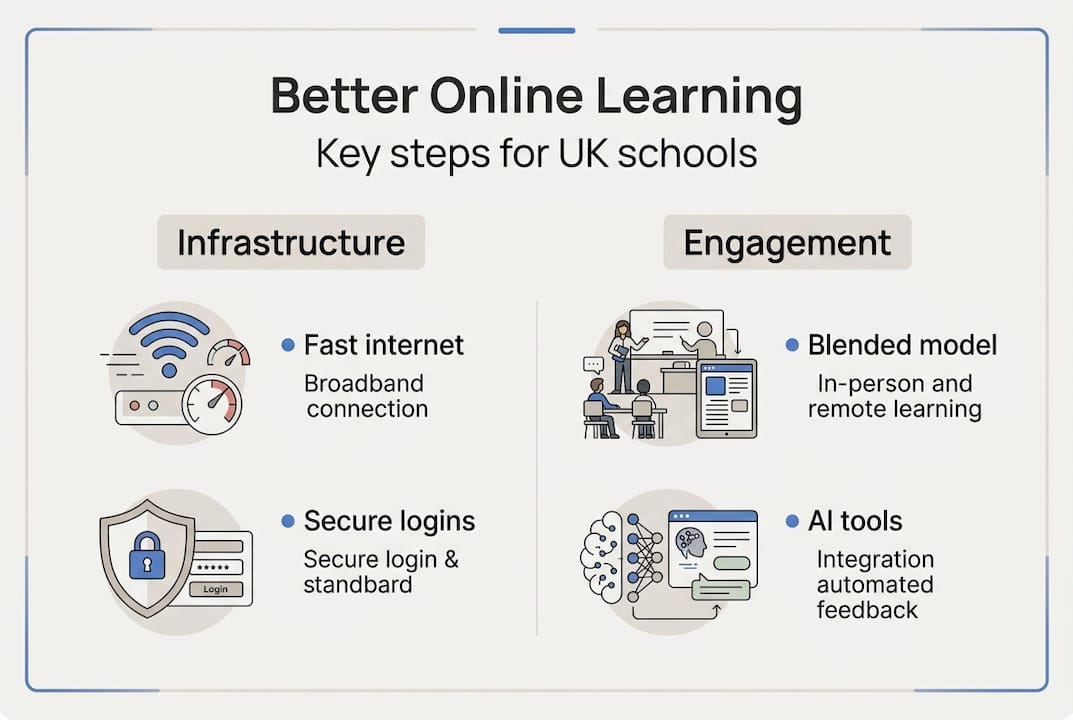
Your online learning success depends entirely on the reliability of your underlying infrastructure. Without stable connectivity and strategic planning, even the most innovative pedagogical approaches will fail. Currently, 67% of primary schools and 97% of secondary schools use full fibre broadband, with the Department for Education investing £45 million to expand connectivity further. If your institution hasn’t yet upgraded, prioritise this immediately.
The DfE requires all schools to meet six core digital standards by 2030, covering infrastructure, data management, digital skills, cyber security, technology leadership, and strategic planning. These standards provide a practical roadmap for your infrastructure development. Use the DfE tracker to assess your current position against these benchmarks and identify priority upgrade areas. Focus particularly on bandwidth capacity during peak usage periods, as simultaneous video conferencing and resource access can overwhelm inadequate networks.
Core infrastructure requirements include:
- Full fibre broadband with sufficient bandwidth for concurrent users
- Enterprise-grade Wi-Fi coverage across all learning spaces
- Device provision meeting minimum technical specifications
- Regular maintenance schedules and technical support capacity
- Backup connectivity solutions for critical operations
- Secure cloud storage with appropriate access controls
Beyond physical infrastructure, you need a clear digital strategy developed collaboratively with teaching staff and IT coordinators. Research shows 70% of secondary schools and 52% of primary schools have established digital strategies, yet many lack alignment between technical capabilities and pedagogical goals. Involve educators in planning sessions to ensure technology serves learning objectives rather than existing as a separate initiative.
Your digital strategy should articulate specific goals, timelines, budget allocations, training requirements, and success metrics. Communicate this plan school-wide through staff meetings, parent newsletters, and governance reports. Schedule quarterly reviews to adapt the strategy as new challenges emerge or opportunities arise. For multi-academy trust websites and larger organisations, ensure consistency across sites while allowing flexibility for individual school contexts.
“Reliable digital infrastructure forms the foundation for every successful online learning initiative. Without it, engagement suffers and staff frustration increases exponentially.”
Pro Tip: Leverage government funding initiatives such as the DfE’s connectivity programme and EdTech demonstrator grants to defray upgrade costs. Many schools overlook available financial support that could accelerate their infrastructure improvements.
Partnering with experienced providers like eSchools can streamline your infrastructure planning and ensure compliance with evolving DfE requirements. Their expertise in digital infrastructure investment helps schools avoid common pitfalls and maximise return on technology spending.
Adopt blended learning models and integrate AI tools ethically to enhance learning outcomes
Once your infrastructure foundation is secure, focus on instructional delivery methods that maximise engagement and outcomes. Evidence overwhelmingly supports blended learning approaches over fully online instruction. A comprehensive meta-analysis found blended learning achieves an 83% superior outcome rate compared to 74% for online-only courses. This difference stems from the complementary strengths of face-to-face interaction and digital flexibility.
| Factor | Blended learning | Fully online learning |
|---|---|---|
| Student engagement | High through varied modalities | Moderate, requires strong self-direction |
| Learning outcomes | 83% superior rate | 74% superior rate |
| Teacher workload | Balanced across formats | Heavy digital management burden |
| Flexibility | Moderate scheduling constraints | Maximum flexibility |
| Social connection | Strong peer and teacher bonds | Limited, requires intentional design |
Design your blended model to leverage the best of both worlds. Use face-to-face sessions for complex concept introduction, collaborative activities, and relationship building. Reserve online components for practice, revision, extension work, and asynchronous discussion. This structure allows you to personalise learning pathways whilst maintaining the social fabric essential for wellbeing and motivation.
Artificial intelligence offers powerful capabilities to enhance both online and face-to-face elements of your blended approach. Current data shows 44% of teachers use generative AI at least sometimes, though only 21 to 25% of schools provide formal AI training. This gap creates risks of inconsistent or inappropriate use. AI can automate routine tasks like marking objective assessments, generating differentiated resources, drafting lesson plans, and providing immediate feedback on student work.

Consider how AI might reduce your staff’s administrative burden. A science teacher could use AI to generate multiple versions of a quiz at different difficulty levels, saving hours of manual adaptation. An English department might employ AI to provide initial feedback on essay drafts, allowing teachers to focus on higher-order guidance about argument structure and evidence use. These applications free educators to spend more time on the irreplaceable human elements: building relationships, facilitating discussion, and providing nuanced support.
Best practices for ethical AI integration include:
- Maintain transparency about when and how AI is used in teaching and assessment
- Ensure human oversight of all AI-generated content before student use
- Protect student data privacy with robust security measures
- Teach students to critically evaluate AI outputs and understand limitations
- Regularly review AI tools for bias and accuracy issues
- Document AI usage policies in your digital strategy
- Provide opt-out options where appropriate
Pro Tip: Establish an AI working group with representatives from teaching staff, leadership, IT, and governance to develop school-specific guidelines. This collaborative approach builds ownership and addresses concerns proactively rather than reactively.
Integrate AI training into your continuous professional development programme. Teachers need hands-on experience with tools, discussion of ethical considerations, and ongoing support as capabilities evolve. The eSchools blog offers practical guidance on emerging educational technology, helping you stay current with AI usage in UK schools and implementation strategies. Their school mobile app demonstrates how thoughtful technology design can enhance communication without overwhelming users, a principle equally applicable to AI integration.
Remember that blended learning outcomes depend on thoughtful design, not simply adding technology to existing practice. Review your curriculum to identify where digital tools genuinely enhance learning versus where traditional methods remain superior. This discernment prevents technology for technology’s sake and maintains focus on educational outcomes.
Use learning analytics and staff training to monitor progress and ensure equity
Effective online learning requires continuous monitoring to identify struggling learners before they fall too far behind. Learning analytics dashboards provide real-time visibility into engagement patterns, assignment completion, assessment performance, and participation metrics. UK higher education case studies demonstrate improved retention using analytics dashboards, with early alert systems enabling timely intervention.
| Metric | What it reveals | Intervention trigger |
|---|---|---|
| Login frequency | Basic engagement level | No logins for 3+ days |
| Time on task | Depth of engagement | Consistently below class average |
| Assignment submission rate | Work completion patterns | Missing 2+ consecutive tasks |
| Assessment scores | Learning comprehension | Decline of 15+ percentage points |
| Discussion participation | Social learning engagement | Zero contributions in 2+ weeks |
| Resource access | Study behaviour | Not accessing key materials |
Configure your analytics system to generate automated alerts when students meet intervention criteria. Assign pastoral staff or tutors to follow up promptly with targeted support. This proactive approach prevents the disengagement spiral where struggling students withdraw further from online learning. Analytics also reveal systemic issues: if an entire class shows low engagement with a particular resource, the problem likely lies with the resource design rather than student motivation.
Equally important is ensuring all staff possess the skills and confidence to deliver effective online learning. Research identifies cost and training access as main barriers to technology adoption, with persistent equity issues affecting both staff and students. Your training programme should address:
- Technical proficiency with your chosen platforms and tools
- Pedagogical strategies for online and blended environments
- Digital accessibility and inclusive design principles
- Trauma-informed approaches for vulnerable learners
- Data privacy and cyber security awareness
- Time management and workload balance in digital contexts
Schedule training throughout the academic year rather than concentrating it at the start of term. This spacing allows staff to apply new skills, encounter real challenges, and return for follow-up support. Differentiate training by experience level, offering advanced sessions for confident users alongside foundation courses for those less comfortable with technology.
Pro Tip: Collect regular feedback from staff about emerging training needs and technology frustrations. Anonymous surveys or suggestion boxes help surface issues that educators might hesitate to raise in formal meetings. Use this intelligence to adapt your professional development programme continuously.
Equity considerations extend beyond staff to students. Design online learning to accommodate pupils with special educational needs, those from disadvantaged backgrounds, refugee students, and others facing barriers to digital access. Provide devices and connectivity support where needed. Ensure all digital content meets accessibility standards for learners with visual, auditory, or cognitive impairments. Offer flexible deadlines and alternative formats to reduce disadvantage.
The eSchools blog regularly features case studies of schools successfully addressing digital barriers and equity challenges. Their school mobile app exemplifies inclusive design that works across device types and connectivity conditions, ensuring no family is excluded from school communication. Apply these same principles to your learning platforms.
Monitor equity metrics alongside academic outcomes. Track technology access rates, support request patterns, and achievement data disaggregated by demographic factors. If certain groups consistently underperform in online contexts, investigate root causes and adjust your approach. True educational equity requires intentional design and ongoing vigilance, not assumptions that digital tools automatically level playing fields.
Regularly review your learning analytics impact to ensure data-driven decision making actually improves outcomes. Analytics are tools, not solutions. They reveal patterns that require human interpretation and response. Combine quantitative dashboard data with qualitative feedback from students and staff to build a complete picture of your online learning effectiveness.
Explore eSchools solutions to support your school’s online learning success
Transforming online learning requires both strategic vision and practical tools that work reliably in real school environments. eSchools specialises in supporting UK educational institutions through this transformation journey.
Their comprehensive platform helps schools meet DfE digital standards whilst supporting blended learning approaches that maximise student outcomes. From school websites designed for intuitive navigation to learning platforms that integrate seamlessly with existing systems, eSchools provides the infrastructure foundation your digital strategy requires. Their mobile app facilitates parent communication and digital engagement, ensuring your online learning initiatives extend beyond the classroom. With over 14 years of experience serving schools and multi-academy trusts, eSchools understands the unique challenges you face. Explore eSchools work to see how tailored solutions can accelerate your institution’s online learning success whilst reducing implementation complexity and ongoing management burden.
What are the first steps to improve online learning in my school?
How should I begin the improvement process?
Start by assessing your current digital infrastructure against DfE standards using the DfE tracker to identify gaps. Involve IT coordinators, teaching staff, and leadership in collaborative planning sessions to develop a digital strategy aligned with your pedagogical goals. Use baseline data on connectivity, device provision, and staff confidence to prioritise initial investments.
Which areas should receive immediate attention?
Focus first on infrastructure reliability, as unstable connectivity undermines all other improvements. Then address staff training needs to build confidence with existing tools before introducing new technologies. Use analytics to identify specific pain points in your current online learning provision and target resources accordingly.
How can AI be safely integrated into online learning?
What safeguards ensure ethical AI use?
Introduce AI gradually with comprehensive staff training that covers both capabilities and limitations. Maintain complete transparency with students and parents about when AI is used and for what purposes. Establish clear policies requiring human oversight of all AI-generated content before student use, and implement robust data privacy protections that exceed minimum legal requirements.
How do I build staff confidence with AI tools?
Provide hands-on training sessions where teachers experiment with AI in low-stakes contexts before classroom deployment. Create a supportive environment where questions and concerns are welcomed. Share examples from the eSchools blog showing successful AI integration in similar schools. Pair confident users with those needing more support through mentoring arrangements.
What measures ensure equitable access to online learning?
How can schools close digital divides?
Invest in staff training to reduce skills gaps that disadvantage certain learner groups. Use trauma-informed design principles when creating online learning experiences for pupils with special educational needs and refugee students. Address cost barriers proactively by providing devices and connectivity support to families who need it, rather than waiting for problems to emerge.
What role does inclusive design play?
Ensure all digital content meets accessibility standards for learners with disabilities. Offer flexible deadlines and alternative formats to accommodate diverse circumstances. Regularly collect feedback from students and families about barriers they encounter, then act on this intelligence to refine your approach. Partner with experienced providers like eSchools who prioritise inclusive design in their platform development.