
TL;DR:
- A school’s digital presence encompasses every online touchpoint that supports safeguarding, communication, and community engagement. Establishing secure, well-governed digital infrastructure is crucial to ensure reliability, safety, and inclusive access for all users. Continuous review and strategic prioritization of digital systems enhance engagement, trust, and educational outcomes across the entire school community.
Your school’s digital presence is not simply a branding exercise or a box-ticking exercise for governors. It is the foundation on which safeguarding, equitable access, and meaningful communication with parents, pupils, and staff are built every single day. UK schools are facing growing DfE expectations around secure, well-governed digital infrastructure, and the schools that are thriving are treating their digital presence as a whole-school strategic priority. This article explains what digital presence really means, why secure foundations matter, and how practical tools can transform engagement and inclusion across your whole school community.
Table of Contents
- What is digital presence in schools?
- Why secure digital foundations are crucial
- How digital presence enhances engagement and inclusivity
- Practical pitfalls and expert tips for school digital presence
- Why the standard advice for digital presence often misses the mark
- Take your school’s digital presence further
- Frequently asked questions
Key Takeaways
| Point | Details |
|---|---|
| Secure digital foundations | Prioritising DfE standard-compliant infrastructure ensures safe, reliable and accessible communication in schools. |
| Inclusive engagement | Accessible digital tools improve communication and involvement across students, staff, and parents. |
| Safeguarding advantage | Robust digital presence supports safeguarding and data protection policies. |
| Avoid common pitfalls | Steer clear of inconsistency and neglect by regularly auditing digital channels and consulting end-users. |
| Strategic digital planning | View digital presence as a long-term school strategy, not just a website upgrade project. |
What is digital presence in schools?
Many school leaders hear “digital presence” and immediately think of a website redesign or a new logo. In reality, your school’s digital presence covers every online touchpoint that connects your community: your website, communication apps, social media channels, management information systems (MIS), digital signage, and even the screens in your reception area.
Each of these channels plays a role in shaping how parents perceive your school, how pupils access learning, and how staff communicate with one another. Taken together, they either strengthen or weaken trust in your institution. Poor digital presence can lead to misinformation, missed safeguarding alerts, and families feeling excluded from school life.
The elements of a school’s digital presence typically include:
- School website: Your primary public-facing channel, carrying statutory DfE-required information and serving as the first point of contact for prospective families.
- Communication platforms: Apps, emails, and SMS tools that keep parents informed about day-to-day events, safeguarding updates, and learning progress.
- Social media: Channels that showcase school culture and achievements, reaching wider audiences including alumni and the local community.
- MIS and cloud-based tools: Back-office systems that integrate data securely and support staff in delivering personalised communication.
- Digital signage: In-school screens that display announcements, achievements, and safety information in real time.
Understanding the breadth of digital presence helps you invest more strategically. Rather than focusing all resource on one channel, effective schools distribute effort across touchpoints to achieve consistent, reliable communication. You can read more about achieving digital engagement outcomes to see how this plays out in practice.
Importantly, digital presence also matters for safeguarding, reliability, and equitable access. The DfE’s standards for schools set an expectation that schools build secure, well-governed digital foundations by 2030, covering connectivity, cyber security, filtering and monitoring, and digital leadership and governance. Following school website compliance guidance is no longer optional; it is integral to your accountability framework. Schools exploring broader visibility can also draw on digital marketing approaches that have proven effective in education settings.
Having set the scene for digital presence, let us explore why secure digital foundations are essential for schools.
Why secure digital foundations are crucial
Think of your school’s digital infrastructure as the plumbing behind the walls. When it works, nobody notices. When it fails, everything stops. Secure digital foundations are what allow your communication tools, learning platforms, and safeguarding systems to function reliably and safely.
The DfE’s six core standards expected by 2030 cover a clear set of priorities:
| DfE standard area | What it means for your school |
|---|---|
| Broadband internet | Reliable, high-speed connectivity for all users |
| Wireless network | Consistent Wi-Fi coverage across every learning space |
| Network switching | Robust switching infrastructure to manage traffic |
| Digital leadership and governance | Clear ownership and accountability for technology decisions |
| Filtering and monitoring | Age-appropriate content controls and audit trails |
| Cyber security | Protection against data breaches, ransomware, and threats |
Each of these areas is interconnected. Weak broadband undermines your wireless network. Poor filtering creates safeguarding risk. Without clear digital leadership and governance, even well-funded infrastructure can be mismanaged. Schools that invest in only one or two of these areas often find that their broader digital presence underperforms as a result.
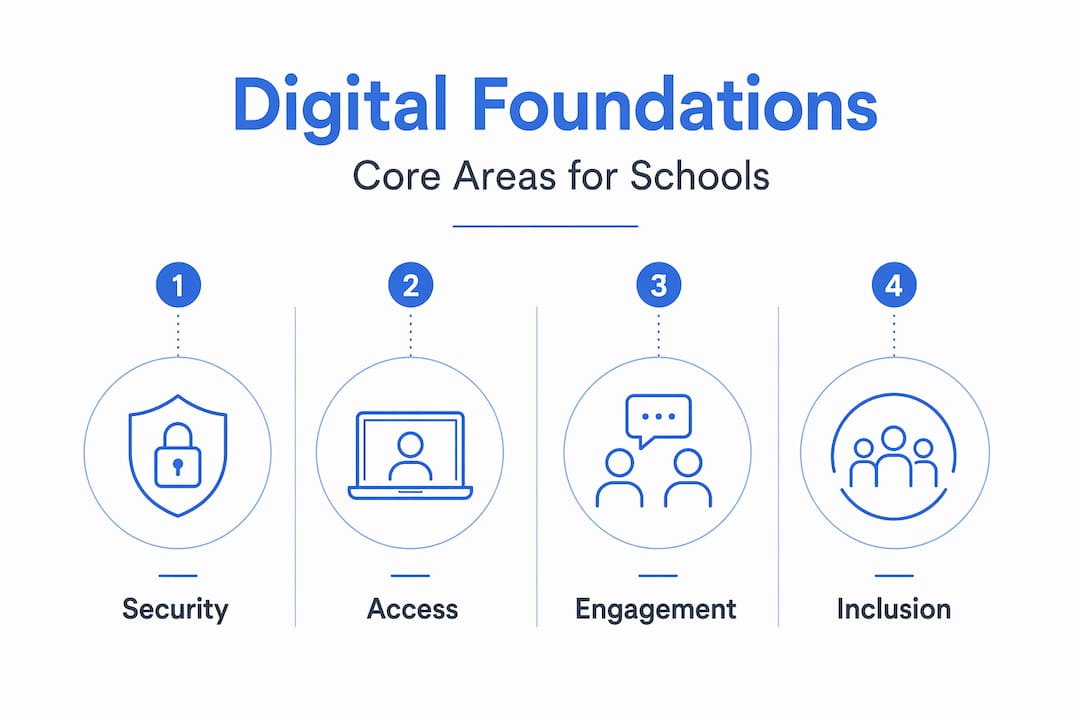
Cyber security deserves particular attention. Ransomware attacks on UK schools have increased significantly in recent years, with attackers targeting institutions that store sensitive pupil and staff data. A breach does not just create operational disruption; it can trigger Ofsted scrutiny and damage community trust for years. Ensuring your infrastructure meets the DfE’s expectations is therefore both a legal responsibility and a reputational safeguard. You can review guidance on online learning security to understand what this looks like in practice, and use the DfE tracker to monitor your school’s progress against each standard area.
An accessible infrastructure checklist can also help you audit your current position and identify gaps before they become critical.
Pro Tip: Before you invest in new communication tools or engagement apps, complete a cyber security and filtering audit. If your foundations are not secure, additional digital channels simply increase your attack surface and risk profile.
Once secure digital foundations are established, schools can realise the communication and engagement benefits of their digital presence.
How digital presence enhances engagement and inclusivity
A secure, well-managed digital infrastructure creates the conditions for something genuinely transformative: meaningful, inclusive communication with every part of your school community. This is where digital presence moves from a compliance obligation to a genuine driver of educational outcomes.

Consider the difference between traditional and digital communication approaches for parents:
| Communication method | Traditional approach | Digital approach |
|---|---|---|
| Absence notifications | Phone calls, paper notes | Automated app alerts with instant confirmation |
| Newsletter distribution | Printed copies, post | Instant digital delivery, multilingual options |
| Parents’ evening booking | Paper slips, telephone queues | Online booking with real-time availability |
| Safeguarding alerts | Letters home | Immediate push notifications with read receipts |
| Academic progress updates | Termly reports | Ongoing access via parent portal |
The digital approach is faster, more reliable, and far more accessible. Families who speak English as an additional language can use translation tools integrated into digital platforms. Parents with mobility difficulties can engage fully from home. Pupils in rural areas or those recovering from illness can access learning and updates without disadvantage.
Evidence from St Mary’s C of E Primary School confirms that digital presence and digital communication can improve inclusivity and student and parent understanding of school life when content is designed to be accessible and visible across multiple audiences. The school’s implementation of MIS-integrated cloud telephony significantly improved response times and reduced the burden on office staff, while giving parents clearer, more consistent information.
“By integrating our MIS with cloud telephony, we saw a marked improvement in how quickly families received updates and how reliably they responded. Communication became a two-way conversation rather than a one-way broadcast.” St Mary’s C of E Primary School, via HBT Communications
Digital signage inside school buildings adds another layer of inclusion. Screens in reception areas, corridors, and dining halls can display real-time information, celebrate pupil achievements, and communicate important updates to visitors and families who attend the school in person. This is particularly valuable for parents who do not regularly engage with apps or email. Understanding the full digital engagement process helps schools use each channel strategically rather than in isolation.
Practical steps to improve inclusivity through digital presence include:
- Using plain English and offering translated versions of key communications
- Ensuring your website meets WCAG 2.1 accessibility standards for users with visual or cognitive impairments
- Integrating MIS data with parent-facing apps to reduce manual data entry and errors
- Deploying digital signage to reach audiences who are physically present in school
- Offering multiple contact channels so families can choose how they communicate
For deeper guidance on reaching families effectively, explore our resources on engaging parents online and review practical school communication tips. Schools interested in extending digital creativity beyond communication can also consider tech tools for creativity that enhance the pupil experience.
With engagement and inclusion benefits clear, schools must navigate the nuanced challenges of implementation across diverse contexts.
Practical pitfalls and expert tips for school digital presence
Even schools with the best intentions make avoidable mistakes when building their digital presence. Recognising these pitfalls early saves time, money, and reputational risk.
Here are the five most common mistakes school leaders and IT coordinators make, and how to avoid them:
-
Neglecting governance before launching new tools. Many schools add communication apps, social media accounts, or online platforms without first assigning clear ownership. When staff leave, accounts become abandoned and inconsistent. Assign a named digital lead for each channel and document your governance structure before going live.
-
Treating accessibility as an afterthought. Accessibility is not optional. WCAG 2.1 compliance and multilingual support should be built into your digital presence from the start, not retrofitted later. Audit your existing website and communications for accessibility gaps at least annually.
-
Over-complicating your technology stack. Schools sometimes adopt too many disconnected tools, creating confusion for staff and parents alike. A smaller number of well-integrated platforms, chosen to work together and connect with your MIS, will almost always outperform a sprawling collection of standalone apps.
-
Ignoring the DfE’s foundational standards. Communications and learning technology are constrained by the broader DfE digital-standards foundations. Without reliable connectivity, cyber security, and filtering and monitoring, digital channels may be unreliable or unsafe, directly undermining your engagement goals. Check your school’s baseline before scaling digital communications.
-
Failing to consult stakeholders. Building a digital presence without gathering input from parents, pupils, and staff leads to poor adoption. Run short surveys, hold focus groups, and use data from your existing platforms to understand what your community actually needs before you invest.
Pro Tip: Schedule a digital presence audit at least once per academic year. Review your website for compliance gaps using the DfE’s requirements, check all communication channels for consistency, and gather feedback from parents and staff on what is working. This is far less costly than fixing problems after an Ofsted inspection or a data breach.
For schools looking to build a stronger evidence base before investing, our educational technology guide and our resource on integrating educational technology in UK schools provide practical frameworks. Schools navigating social media strategy can also find structured approaches in specialist social media marketing guidance tailored to educational settings.
Having seen the landscape and pitfalls, here is a candid take from seasoned practitioners on what actually works.
Why the standard advice for digital presence often misses the mark
Most articles about school digital presence tell you to refresh your website, post more on social media, and send a weekly newsletter. That advice is not wrong, but it is incomplete. It treats digital presence as a communications project when it is, in reality, a whole-school leadership challenge.
The schools that are genuinely succeeding with digital presence share three characteristics that rarely feature in standard guidance. First, their headteacher or MAT CEO treats digital infrastructure as a strategic priority, not a delegated IT task. Second, they have embedded accessibility and inclusion into their digital planning from the outset, not bolted them on after a complaint. Third, they review their digital presence continuously, treating it as a living system rather than a one-off project that gets revisited every few years.
The schools that struggle tend to do the opposite. They invest in visible outputs like a new website or a parent app, without addressing the underlying infrastructure, governance, or consultation processes that make those tools effective. When Ofsted asks about safeguarding or parental engagement, the gaps become apparent quickly.
There is also a timing problem. Many schools wait until there is a crisis, whether that is a data breach, an accessibility complaint, or a drop in parental satisfaction scores, before taking digital presence seriously. By that point, the reputational damage is already done and the cost of recovery is significantly higher.
Our view is that digital presence should appear on every school’s improvement plan, reviewed alongside teaching and learning outcomes. The digital engagement process is not a one-time project; it is an ongoing cycle of planning, delivery, review, and improvement. Schools that embed this cycle into their culture consistently outperform those that treat digital presence as a periodic task.
Take your school’s digital presence further
If this article has clarified the scope of your school’s digital challenge, the next step is to see what practical solutions look like in action. eSchools has worked with hundreds of UK schools and multi-academy trusts to build bespoke, compliant, and genuinely engaging digital environments.

Our school websites are designed to meet DfE statutory requirements out of the box, with built-in accessibility features and intuitive content management that does not require technical expertise. You can explore examples of digital school solutions from real schools to see how others have approached the challenge. And if you want immediate, actionable steps, our communication engagement tips give you a structured starting point for improving parent and pupil engagement this term.
Frequently asked questions
How do DfE digital standards affect school digital presence?
The DfE’s six core standards set clear requirements for broadband, wireless networks, security, and leadership, forming the foundation for safe and accessible digital communication in schools. Schools that meet these standards are better placed to deploy reliable communication tools, protect pupil data, and demonstrate compliance to Ofsted.
What are the main benefits of an effective school digital presence?
The main benefits are improved safeguarding, equitable access, enhanced communication, and greater parent and student engagement. Evidence from schools using integrated digital systems, including the St Mary’s case study, confirms that accessible digital communication improves inclusivity and understanding for the whole school community.
How can schools make their digital communications accessible for all parents?
Schools should use accessible formats, multi-language tools, and cloud-based systems so information is easy to find and share across devices. As shown in the St Mary’s case study, integrating telephony and MIS systems can significantly improve responsiveness for families with language barriers or limited digital confidence.
What common mistakes do schools make with digital presence?
Common mistakes include neglecting cyber security, using inconsistent communication channels, and failing to consult families about their needs. As the DfE’s standards make clear, communications technology is only as reliable as the foundational infrastructure supporting it.
Which tools can help schools improve digital engagement?
MIS-integrated apps, cloud telephony, digital signage, and accessible online platforms have been proven to increase engagement and responsiveness. Case study evidence shows that digital signage and school-wide communication platforms improve parent and student understanding of school life when implemented with accessibility and inclusion in mind.