
TL;DR:
- Effective EdTech requires pedagogy, strategy, and proper implementation, not just hardware purchases.
- Successful integration depends on evidence-based decisions, staff training, infrastructure, and ongoing evaluation.
- UK schools must align with DfE standards, address the digital divide, and foster a culture of experimentation.
Adopting a new device trolley or signing up for the latest platform does not, by itself, improve outcomes. Many school leaders discover this the hard way, spending budget and goodwill on tools that gather digital dust within a term. Educational technology, or EdTech, is far broader than hardware purchases; it is the study, ethical practice, and application of technological processes, software, and educational theories to facilitate learning and improve teaching. This guide moves from a clear definition through UK-specific frameworks, regulations, and honest evidence, so you can make confident, strategic decisions rather than reactive ones.
Table of Contents
- Defining educational technology in schools
- Key frameworks, pedagogy, and evidence-based integration
- Regulations, standards, and digital priorities for UK MATs
- Benefits, challenges, and the real impact of EdTech in practice
- Our perspective: what UK schools miss about successful EdTech
- Next steps: take educational technology further in your school
- Frequently asked questions
Key Takeaways
| Point | Details |
|---|---|
| Pedagogy first | Choose and implement EdTech by starting with teaching goals and learner needs, not technology for its own sake. |
| Evidence and value | Use best available research and invest where tools show measurable, cost-effective benefit for your context. |
| Meet DfE standards | Prioritise compliance with the UK’s six digital standards and make use of government guidance for selection. |
| Monitor impact | Review outcomes regularly to ensure EdTech is making a positive difference and adjust approaches as needed. |
| Mind the risks | Don’t ignore digital divides, cognitive and motivational side-effects, or the need for ongoing training and equity. |
Defining educational technology in schools
Educational technology is not simply about screens in classrooms. As Wikipedia defines it, EdTech encompasses the study, ethical practice, and application of technological processes, hardware, software, and educational theories to facilitate learning, improve performance, and enhance teaching methodologies. That definition matters because it tells you that technology is only one strand; the theories and practices that surround it are equally important.
To make this concrete, consider how EdTech breaks down in a typical school or multi-academy trust setting:
| Category | What it includes | School examples |
|---|---|---|
| Hardware | Physical devices and infrastructure | Tablets, interactive whiteboards, broadband |
| Software and platforms | Digital tools for content and management | Learning Management Systems, assessment apps |
| Pedagogical approach | Teaching theory underpinning tool use | Blended learning, flipped classroom models |
| Administrative technology | Operational and communication tools | Parent communication systems, booking platforms |
Each category connects to the others. A school that buys tablets without a coherent software strategy, or deploys a Learning Management System (LMS) without training staff on blended learning principles, will see limited return.
On the software side, key EdTech mechanics include LMS platforms such as Moodle or Google Classroom for content management, adaptive platforms using artificial intelligence and machine learning for personalised learning paths, content authoring tools such as Articulate, dedicated assessment platforms, and immersive virtual and augmented reality environments for experiential learning. Each serves a different purpose, and the mistake many schools make is treating them as interchangeable.
“Educational technology is not a single product or system. It is a practice, one that requires ongoing professional judgement about which tools serve which learners in which contexts.”
For UK schools and MATs, this practice also extends into management and communication. Platforms that streamline parent communication, automate routine tasks, and present a school’s digital presence clearly are just as much a part of EdTech as a classroom assessment tool. When thinking about integrating educational technology across your organisation, you need a map that covers all four categories, not just the ones that generate headlines.
The role EdTech plays in management is often underestimated. A well-chosen school website or parent booking system can reduce administrative hours considerably, freeing staff to focus on learning. That is a genuine educational outcome, even if it does not show up in a pupil attainment spreadsheet.
Key frameworks, pedagogy, and evidence-based integration
Now that we have clarified what EdTech is, it is vital to understand how schools should approach it from a pedagogical and evidence-based viewpoint. The most common failure mode is choosing technology first and then looking for a reason to use it. Effective integration works in the opposite direction.
Effective EdTech methodologies emphasise pedagogy-first alignment, drawing on constructivism, the SAMR framework, and a clear distinction between medium (technology as vehicle) and method (the underlying learning theory). Integration should always start from learning objectives, then identify the tools that serve those objectives.
The SAMR model, developed by Dr Ruben Puentedura, gives school leaders a useful lens:
- Substitution: Technology replaces a traditional tool with no functional change (for example, a typed document replacing a handwritten one).
- Augmentation: Technology replaces a tool but adds functional improvement (for example, spell-check and auto-save on a document).
- Modification: Technology allows significant task redesign (for example, pupils collaborating on a shared document in real time).
- Redefinition: Technology enables tasks previously inconceivable (for example, a Year 8 class collaborating with peers in another country via video to produce a joint project).
Most schools operate at Substitution and Augmentation. The real gains, in terms of pupil engagement and deeper learning, come at Modification and Redefinition. Getting there requires deliberate planning, not simply upgrading equipment.
A useful comparison when evaluating any EdTech tool:
| Question to ask | Why it matters |
|---|---|
| What learning objective does this serve? | Prevents technology-for-its-own-sake purchases |
| What does the evidence say about its impact? | Grounds decisions in research, not marketing |
| Is our infrastructure ready to support it? | Avoids failed rollouts due to connectivity issues |
| Have staff had adequate training? | Determines whether the tool will actually be used |
| How will we measure its impact? | Creates accountability and informs future decisions |
When selecting digital classroom tools for your school or trust, running each candidate through this table before purchase will save both money and frustration.
Pro Tip: Pilot any new tool with a small, willing group of staff first. Collect honest feedback after four weeks, not four days. Teachers need time to move beyond initial discomfort before you can judge whether a tool genuinely supports learning.
The constructivist principle is also worth keeping in mind. Pupils learn more effectively when they actively construct understanding rather than passively receive information. Technology should create conditions for that active construction, not replace it with passive screen time. Understanding digital engagement for outcomes requires you to ask whether your chosen tools invite pupils to do something meaningful, or simply to watch and click.
Regulations, standards, and digital priorities for UK MATs
Understanding frameworks is crucial, but real-world decisions hinge on national standards and MAT best practice in the UK. The Department for Education has set clear expectations, and failing to align with them creates both compliance risk and missed opportunity.
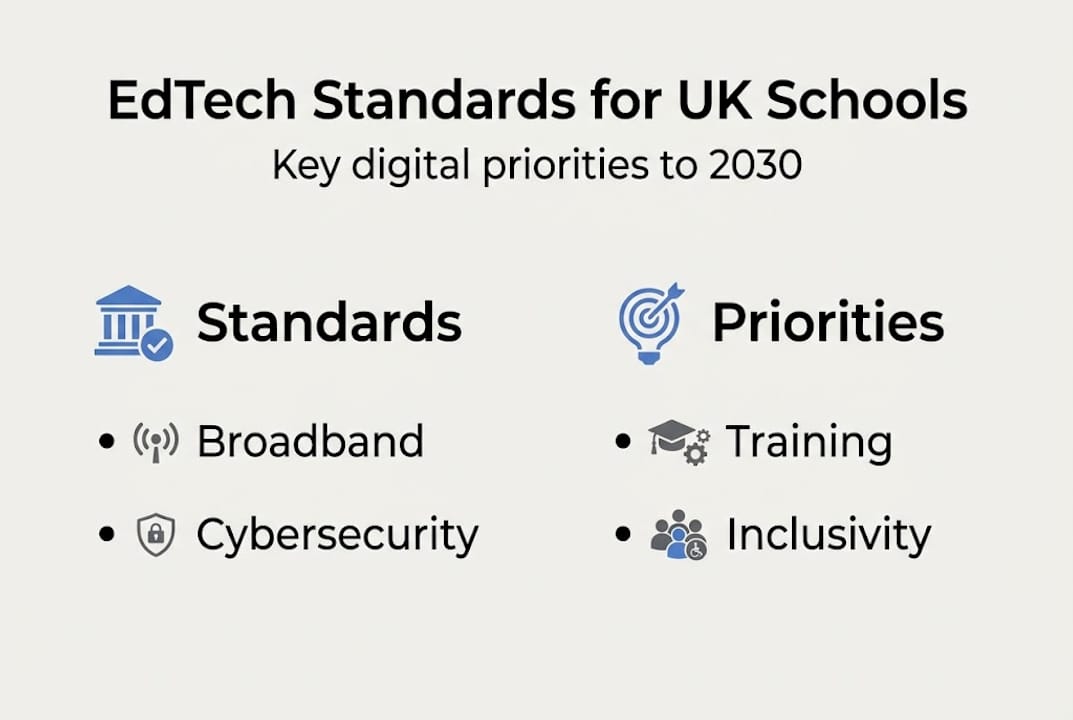
The DfE promotes six digital standards for schools and MATs to achieve by 2030, covering broadband connectivity, secure wireless networks, cybersecurity, cloud services, devices, and digital leadership capability. Alongside this, the EdTech Evidence Board provides a structured approach to evaluating tools before purchase, and the DfE’s “Plan technology for your school” resource supports needs-based investment rather than ad hoc procurement.
For MAT leaders specifically, the landscape is complex. Research from the Education Policy Institute found that MATs prioritise evidence, value for money, and local context when making EdTech decisions, but face significant challenges including a lack of robust evidence for many products, infrastructure gaps between schools within the same trust, and equity concerns about which pupils benefit. Oak National Academy is used in 75% of schools and has been shown to reduce teacher workload by a median of four hours per week, making it one of the clearest examples of evidence-based EdTech delivering measurable value.
Key priorities for MAT leaders when making EdTech decisions:
- Evidence first: Only invest in tools with credible, independent evidence of impact, not just vendor case studies.
- Value for money: Consider total cost of ownership, including training, maintenance, and renewal, not just the headline licence fee.
- Local context: What works in one school within your trust may not translate to another with different demographics or infrastructure.
- Infrastructure readiness: A tool is only as good as the connection it runs on. Audit your broadband and wireless capability before committing to cloud-heavy platforms.
- Equity: Ensure that EdTech investments benefit all pupils, including those with special educational needs, English as an additional language, or limited home access to devices.
- Governance and compliance: School websites, in particular, must meet DfE school website compliance standards, which are a statutory requirement and a regular focus for Ofsted scrutiny.
The governance dimension is often overlooked in EdTech conversations. Your digital presence is not just a communication tool; it is a statutory obligation.
Benefits, challenges, and the real impact of EdTech in practice
What does real-world experience show when EdTech is rolled out in UK schools? The picture is more nuanced than either enthusiastic vendors or sceptical commentators suggest.
On the positive side, 85% of teachers report that EdTech has a positive impact on their practice, citing personalisation of learning, improved pupil engagement, and reduction in workload through automation. Adaptive platforms, for example, can identify where individual pupils are struggling and adjust content accordingly, something a teacher managing thirty pupils simultaneously simply cannot do manually for every child in every lesson.

However, the same research shows that 55% of educators note negative effects on pupil focus and mental health, and there is broad consensus that large-scale measurable gains in attainment require active, purposeful engagement rather than passive use of devices.
Key benefits when EdTech is implemented well:
- Personalised learning paths that respond to individual pupil needs.
- Faster feedback cycles through digital assessment tools.
- Reduced administrative workload for teachers and school office staff.
- Improved communication with parents through integrated platforms.
- Greater access to high-quality resources, including those on improving online learning experience for your school community.
Key challenges that require active management:
- The digital divide, where pupils without home devices or reliable internet are disadvantaged.
- Cognitive offloading, where pupils rely on AI tools to bypass thinking rather than support it.
- Task-switching and distraction on personal devices during lessons.
- Mental health pressures associated with increased screen time.
- Variable and sometimes poor-quality evidence for the products schools are being asked to buy.
The Ada Lovelace Institute’s research highlights that the digital divide exacerbates existing inequalities, that AI-generated content can introduce inaccuracies that lower-attaining pupils are less equipped to spot, and that technology is not neutral; it actively shapes pupil behaviour, including patterns of task-switching that reduce sustained attention.
Some schools have found creative solutions. The use of Minecraft Education in practice, for example, demonstrates how game-based tools can drive genuine problem-solving and collaboration when they are embedded in clear curricular objectives rather than used as reward activities.
Pro Tip: Before rolling out any EdTech tool school-wide, map it against your current safeguarding and data protection obligations. A tool that creates new data flows or pupil-facing accounts may require a Data Protection Impact Assessment under UK GDPR.
The honest conclusion from the evidence is this: EdTech can deliver real benefits, but only when it is chosen carefully, implemented with adequate training, and evaluated honestly. The gap between what vendors promise and what schools experience is often a gap in implementation, not in the technology itself.
Our perspective: what UK schools miss about successful EdTech
Having reviewed the practicalities and pitfalls, here is our editorial view. The most common reason EdTech fails in schools is not that the tools are poor. It is that the strategy around those tools is absent or inconsistent.
Research from RAND is clear that success depends on implementation fidelity, sustained teacher training, and active use of tools after the initial novelty wears off. Schools that see moderate but consistent gains share a common characteristic: they treat EdTech as a professional practice, not a product purchase.
The culture question is the one most school leaders avoid because it is harder than choosing a platform. Building a culture where staff feel safe to experiment, where honest evaluation is welcomed rather than seen as criticism, and where technology choices are driven by learning need rather than budget cycles, is the real work of EdTech leadership.
The advice we offer consistently is to invest as much in user-friendly EdTech for success and staff capability as you do in the tools themselves. A well-trained team using a simple, reliable platform will consistently outperform an undertrained team with sophisticated but poorly-understood technology.
Next steps: take educational technology further in your school
If the evidence and frameworks in this guide have prompted you to reconsider your current EdTech approach, you are in a strong position to make changes that last. eSchools has supported schools and MATs across the UK for over 14 years, delivering school website engagement solutions, compliance-ready digital platforms, and tools designed to reduce administrative burden without adding complexity.

Whether you are a headteacher reviewing your digital presence, an IT coordinator planning infrastructure investment, or a MAT leader looking for consistent solutions across multiple schools, our team can help. Explore our MAT website solutions to see how we support trust-wide digital strategy, or see our EdTech work in practice. We provide tailored guidance aligned to DfE standards and the real priorities of UK school leaders, so you can move forward with confidence.
Frequently asked questions
How does educational technology improve learning outcomes?
When matched to clear objectives and used actively, EdTech can enhance personalisation and reduce teacher workload, but outcomes depend on context and fidelity of use rather than the tool alone.
What are the main challenges of adopting EdTech in UK schools?
Key challenges include infrastructure gaps, inadequate staff training, and ensuring equity, since the digital divide means technology can widen rather than narrow attainment gaps if not carefully managed.
What guidance does the DfE offer for digital technology in schools?
The DfE sets six digital standards for broadband, wireless, cybersecurity, and related areas, with a target of all schools meeting them by 2030 and tools to support evidence-based investment planning.
Who should lead decisions on EdTech purchases in a MAT?
EdTech decisions in MATs are most effective when led collaboratively by teaching, IT, and senior leadership, ensuring that pedagogy, evidence, and infrastructure considerations all inform the final choice.