
TL;DR:
- Digital tools like Oak National Academy save teachers about four hours weekly and improve workload.
- Proper implementation, staff input, and continuous support are crucial for EdTech success.
- Incremental, staff-driven adoption of user-friendly tools yields better long-term workload reductions.
Teacher burnout is not a distant concern for UK school leaders; it is a daily operational reality. Yet the evidence increasingly shows that the right digital tools make a measurable difference. Oak National Academy and Aila AI save teachers a median of four hours per week, with 85% of users reporting a positive workload impact. That figure challenges the assumption that technology inevitably adds complexity. This guide walks you through the real evidence, the genuine risks, and the practical steps your school needs to take to make EdTech work for your staff rather than against them.
Table of Contents
- Understanding teacher workload: The key pain points
- How EdTech solutions automate and streamline daily tasks
- Limits, pitfalls and technostress: When EdTech adds to workload
- From tools to transformation: What makes EdTech successful?
- Our perspective: The reality of EdTech for real schools
- How eSchools helps unlock EdTech’s true benefits
- Frequently asked questions
Key Takeaways
| Point | Details |
|---|---|
| EdTech saves time | AI and digital tools can cut teacher workload by several hours per week when implemented well. |
| Training is essential | Proper onboarding and support are crucial to avoid increasing workload through technostress. |
| Evaluate for impact | Success depends on measuring outcomes and involving teachers in EdTech choices. |
| Beware common pitfalls | Poor integration or lack of staff input can make technology a burden rather than a benefit. |
Understanding teacher workload: The key pain points
To frame our discussion, let us first break down what actually drives teacher workload in UK schools. Workload is not simply about the number of lessons taught. It is the cumulative weight of every task that surrounds teaching: planning, marking, reporting, communicating with parents, completing administrative returns, and attending meetings. When any one of these areas is poorly managed, the entire system feels the strain.
Research consistently identifies the following as the heaviest contributors to teacher time:
- Lesson planning and resource creation: Many teachers report spending several hours each week building materials from scratch, even when suitable resources already exist.
- Marking and feedback: Written feedback remains time-consuming, particularly at Key Stage 3 and above, where class sizes are large and expectations are high.
- Administrative reporting: Attendance registers, pupil progress data, safeguarding logs, and statutory returns all demand consistent, careful attention.
- Parent and carer communication: Emails, letters, newsletters, and one-to-one conversations are essential but frequently unstructured and reactive.
- Meetings and CPD: Continuing professional development (CPD) sessions and briefings, while valuable, often occur outside directed time and blur into personal time.
The consequences of unmanaged workload are well documented. Teacher wellbeing deteriorates, absence rates rise, and recruitment and retention become increasingly difficult. Schools with high staff turnover lose institutional knowledge, disrupt pupil progress, and place additional pressure on remaining colleagues.
The good news is that school leaders are beginning to see results. The Technology in Schools Survey 2024 to 2025 found that 61% of school leaders and 43% of teachers report that technology has reduced workload since 2021/22. That gap between leader and teacher perception is itself instructive: it tells you that implementation and communication matter just as much as the tools themselves.
“The right technology doesn’t just save time. It changes the culture around workload, making it easier for staff to prioritise teaching rather than administration.” This sentiment, shared by many headteachers we speak with, captures exactly why EdTech strategy deserves senior leadership attention.
Understanding these pain points is your starting point. Once you know where time is genuinely being lost, you can target solutions with precision rather than purchasing broadly and hoping for improvement.
How EdTech solutions automate and streamline daily tasks
Once the workload problem is clear, let us see precisely how modern EdTech tools are removing major burdens from teachers’ to-do lists. The most effective solutions address specific bottlenecks rather than attempting to replace entire workflows overnight.
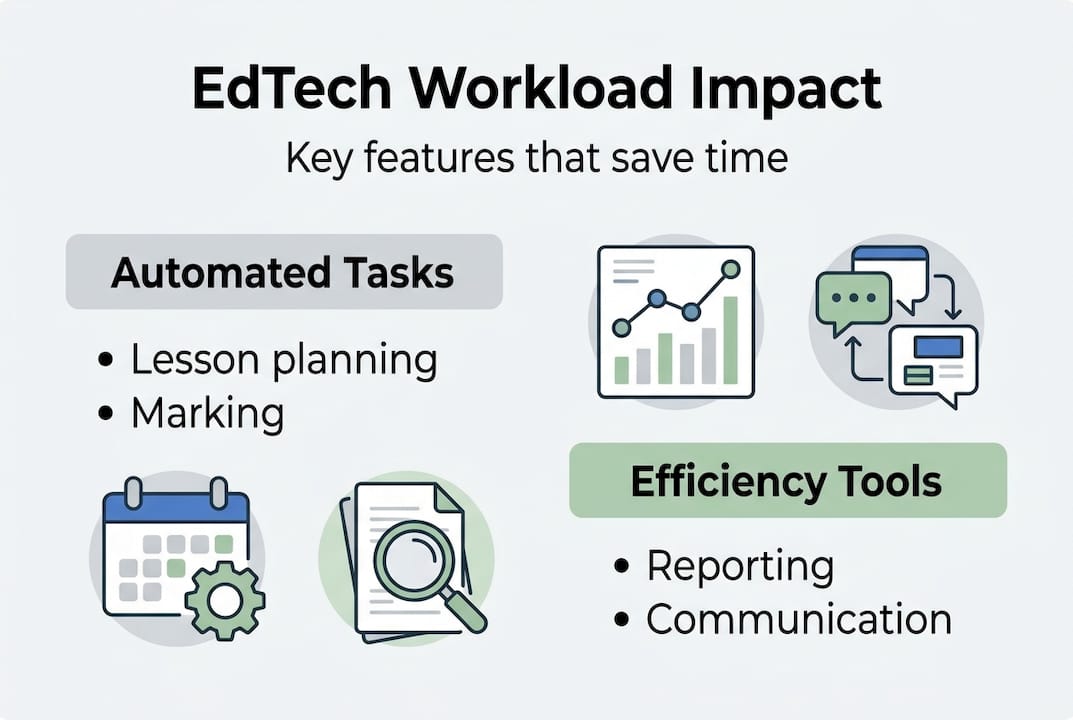
AI-driven EdTech tools, particularly those built for lesson planning and management information, are demonstrably reducing teacher administrative workload by automating planning, marking, and reporting tasks. The evidence is compelling. An Education Endowment Foundation trial found that ChatGPT reduced lesson planning time by 31% for KS3 science teachers, with no measurable loss in lesson quality. That is not a marginal gain. For a teacher spending six hours per week on planning, a 31% reduction means almost two hours returned to them every single week.
Here is how the most impactful EdTech categories address specific workload areas:
| EdTech category | Task automated or streamlined | Estimated time saved per week |
|---|---|---|
| AI lesson planners | Resource creation, differentiation, scheme of work drafting | 1.5 to 2 hours |
| MIS platforms | Attendance, data reporting, statutory returns | 1 to 2 hours |
| Communication tools | Parent newsletters, letters, booking systems | 30 to 60 minutes |
| Online marking tools | Feedback, assessment, moderation | 1 to 1.5 hours |
Management Information Systems (MIS) deserve particular attention. These platforms centralise pupil data, attendance records, and reporting functions into a single interface. When integrated properly, an MIS removes the need for teachers to manually update multiple spreadsheets or chase administrative staff for basic pupil information. This alone can eliminate hours of duplicated effort each term.
To integrate these tools effectively into daily routines, consider the following steps:
- Audit current time use: Ask staff to log how they spend their time across one school week. This gives you a genuine baseline before any technology investment.
- Identify the highest-burden tasks: Focus first on the areas where most time is lost, not the areas where technology looks most impressive.
- Pilot with a small group: Select a volunteer group of teachers to trial a specific tool before committing to a school-wide rollout.
- Measure outcomes explicitly: Track time saved, staff satisfaction, and any change in output quality before expanding the pilot.
- Integrate, do not layer: Wherever possible, connect new tools to existing systems rather than adding standalone platforms that require separate logins and workflows.
Exploring edtech solutions for efficiency at a strategic level, rather than reacting to individual product pitches, puts your school in a much stronger position. Understanding the full landscape of digital classroom tools available to UK schools also helps you compare options with genuine purpose.
Pro Tip: When evaluating any new EdTech platform, ask the provider for a time-on-task case study from a comparable UK school, not just a headline statistic. Real-world data from similar settings is far more reliable than vendor claims.
Limits, pitfalls and technostress: When EdTech adds to workload
Technology is not a silver bullet, and missteps here can backfire. Let us tackle these risks directly, because ignoring them is how well-intentioned EdTech investments become sources of frustration rather than relief.

The concept of technostress, which refers to the anxiety and cognitive load created by complex or poorly implemented technology, is a recognised professional hazard. When a new platform has a steep learning curve, requires significant verification of its outputs, or is introduced without adequate training, it adds to workload rather than reducing it. This is not a theoretical risk; it is a documented pattern across many school technology rollouts.
Poor implementation and insufficient training are the most common reasons EdTech fails to deliver on its promise. Complex tools add learning curves that occupy exactly the time they were meant to free up. A teacher who spends three hours learning to use an AI marking assistant has not saved any time in the short term, and if that training is not followed up with ongoing support, they may abandon the tool entirely.
Watch out for these common pitfalls during any EdTech rollout:
- Insufficient onboarding: A single training session is rarely enough. Staff need repeated exposure, access to guidance materials, and a clear point of contact for ongoing questions.
- Tool overload: Introducing multiple platforms simultaneously overwhelms staff and makes it impossible to attribute any workload change to a specific tool.
- Always-on culture: Communication tools that enable parents or school leaders to contact teachers at any time can blur the boundary between professional and personal time, increasing stress rather than reducing it.
- Non-specialist teachers: Staff who are not confident with technology to begin with may find that AI tools require more oversight and correction than they save.
- Absence of staff input: Tools chosen solely by leadership, without input from the teachers who will use them daily, are far less likely to be adopted effectively.
“Technology should serve teachers, not demand more of them. If your staff are spending more time managing a platform than benefiting from it, that is a sign the rollout has gone wrong, not the staff.”
Understanding the importance of EdTech support is essential before any purchase decision. Equally, having a clear tech integration guidance framework protects your school from reactive procurement. Prioritising user-friendly EdTech is not a luxury; it is a strategic necessity. And as online collaboration trends evolve, choosing tools that staff actually want to use becomes even more critical.
Pro Tip: Before signing any EdTech contract, ask your staff a simple question: “Would you choose to use this tool if it were optional?” Their honest answer will tell you more than any product demonstration.
From tools to transformation: What makes EdTech successful?
To move from risk to reward, leaders need a strategy. Here is how successful schools unlock the real value of EdTech rather than simply accumulating digital tools.
The DfE Technology in Schools Survey is clear on this point: success requires robust training, ongoing evaluation frameworks, and a pedagogy-first design approach. DfE standards also emphasise that safe AI tools should be co-designed with teachers, not simply handed to them. This distinction matters enormously in practice.
Compare two common approaches to EdTech adoption:
| Approach | Top-down, one-size-fits-all | Staff-driven, incremental selection |
|---|---|---|
| Who chooses the tool | Senior leadership only | Leadership with staff input |
| Training provided | One-off session | Ongoing, contextualised CPD |
| Rollout pace | Whole school, immediate | Pilot group, then phased expansion |
| Evaluation process | Informal or absent | Structured, data-informed review |
| Staff buy-in | Low to moderate | High |
| Workload impact | Variable, often negative initially | Consistently positive over time |
The evidence strongly favours the staff-driven model. When teachers are involved in selecting and evaluating tools, they are more likely to use them correctly, flag problems early, and advocate for adoption among colleagues.
Here is a practical action plan for effective EdTech adoption in your school:
- Define the problem first: Be specific. Are you trying to reduce marking time? Improve parent communication? Streamline statutory reporting? Your answer should guide every subsequent decision.
- Engage your teaching staff early: Hold a structured conversation before any procurement begins. Ask staff where they most want time back and what tools, if any, they already use and trust.
- Apply DfE and Ofsted frameworks: Ensure any AI tool meets school DfE compliance standards and does not introduce data protection risks.
- Run a structured pilot: Set a clear timeframe, involve a representative sample of staff, and establish what success looks like before you begin.
- Evaluate with rigour: Use both quantitative data (time saved, tasks completed) and qualitative feedback (staff confidence, satisfaction) to assess impact.
- Scale what works: Only expand tools that show clear evidence of benefit. Retire anything that does not, however impressive it looked at the procurement stage.
Focusing on digital engagement outcomes rather than simply digital adoption is the mindset shift that separates effective EdTech leaders from those who accumulate expensive, underused platforms. A thoughtful approach to classroom tech selection ensures that every tool earns its place in your school’s daily operations.
Pro Tip: Build a simple EdTech review calendar into your school improvement plan. Reviewing tools termly, rather than annually, allows you to catch problems early and make adjustments before they become embedded frustrations.
Our perspective: The reality of EdTech for real schools
Stepping back, let us share what we have seen actually works and what looks good only on paper.
The data on EdTech workload reduction is encouraging. But data from well-resourced pilots does not always translate cleanly into the realities of a busy primary school with one part-time IT coordinator, or a large secondary navigating staff changes mid-year. The gap between headline statistics and lived experience is where many school technology investments quietly fail.
What we consistently observe is this: schools that adopt user-friendly EdTech incrementally, starting with one or two tools that address a specific, painful problem, achieve better long-term outcomes than those that invest in comprehensive platforms all at once. Complexity is not a feature. It is a barrier.
The most important variable is not the technology itself. It is whether your staff feel heard throughout the process. Ongoing feedback loops, even informal ones, reveal problems early and build the kind of trust that makes future adoption far smoother. Less complexity, sustained by genuine support, consistently outperforms the latest and greatest platform adopted at speed and then quietly abandoned.
How eSchools helps unlock EdTech’s true benefits
For leaders ready to put these lessons into practice, here is how eSchools supports your journey.

eSchools brings over 14 years of experience supporting UK schools with digital tools that are genuinely simple to use. From bespoke school websites to centralised MAT website solutions, communication platforms, and parent evening booking systems, every product is designed to reduce staff burden rather than add to it. You can explore how schools use eSchools in practice, or read more about school administration software designed to streamline UK school operations. If your goal is to free up teacher time and improve operational efficiency, eSchools is ready to help you get there.
Frequently asked questions
How much time can EdTech realistically save a teacher per week?
Recent studies show that teachers save a median of four hours per week using platforms such as Oak National Academy and Aila AI, with 85% of users reporting a positive impact on their workload.
Does EdTech reduce workload for all teachers or just some?
Most teachers benefit, but those with limited digital confidence or poor access to training may find their workload unchanged or increased, which is why tailored onboarding and ongoing support are essential for all staff.
What are the main features of EdTech that impact teacher workload?
Automated planning, marking, and reporting alongside centralised communication tools are consistently the most powerful features for reducing teacher workload in UK schools.
What pitfalls should leaders avoid when rolling out EdTech?
Without proper training and staff involvement, complex tools add learning curves that increase technostress and can make workload worse rather than better, particularly in the early stages of adoption.
How do school leaders measure the impact of EdTech on workload?
The most practical approach is to compare baseline hours spent on administrative and planning tasks before and after rollout, supported by structured staff surveys, a method aligned with the findings of the Technology in Schools Survey 2024 to 2025.