TL;DR:
- A school website should have clear, measurable goals aligned with engagement and compliance.
- Usability, accessibility, and tailored interactive tools are essential for effective communication.
- Measuring performance and outcomes is more important than aesthetics for meaningful school website improvements.
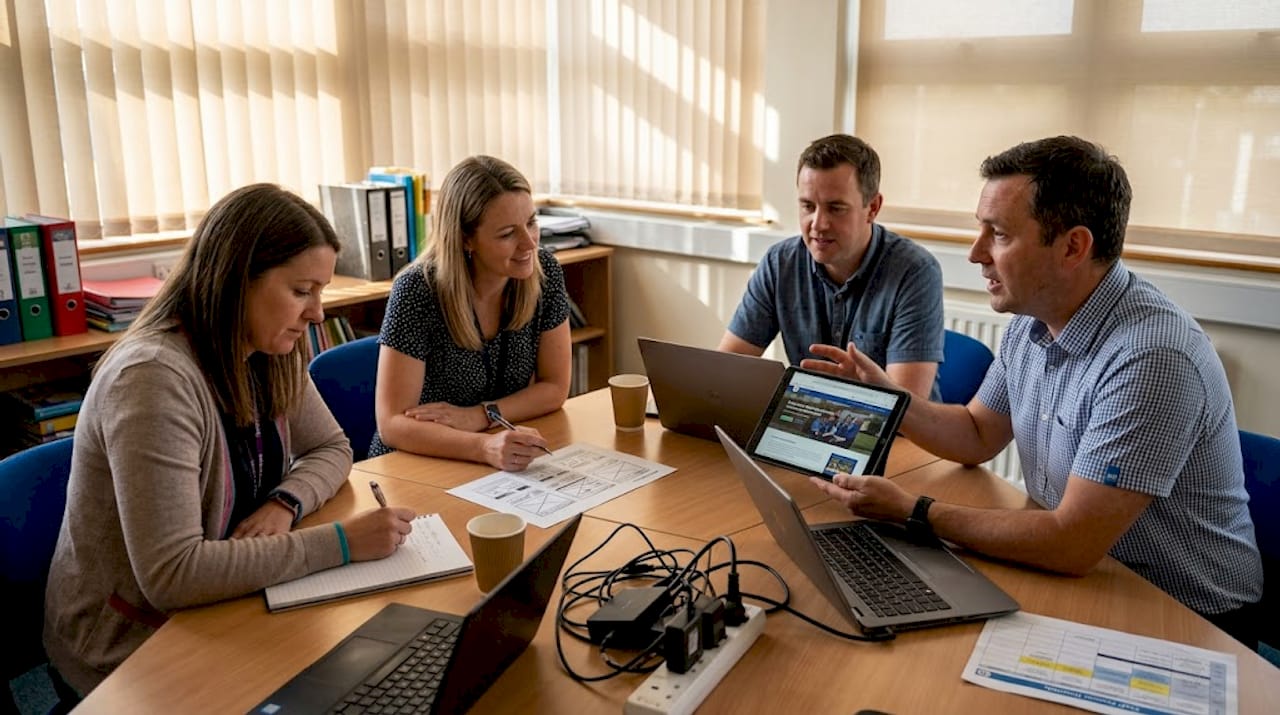
Your school website is far more than a digital brochure. It is the primary platform through which parents, students, and the wider community form their first impression of your school, access critical information, and stay connected with daily life. Yet many schools still rely on opinion and aesthetics alone when making design decisions, rather than evidence-backed strategies with measurable outcomes. This article sets out concrete, practical tips for school administrators and IT coordinators who want to move beyond guesswork and build a website that genuinely improves communication, drives engagement, and meets the expectations of a modern UK school community.
Table of Contents
- Set clear, measurable goals for your school website
- Design for usability and accessibility in education
- Enhance engagement with interactive and tailored content
- Streamline school communication through website integration
- What most school website guides miss: measurable impact over aesthetics
- See how eSchools transforms school websites in the UK
- Frequently asked questions
Key Takeaways
| Point | Details |
|---|---|
| Set clear goals | Define measurable targets for engagement and communication before redesigning your school website. |
| Prioritise usability | Design with accessibility, logical navigation, and mobile-friendliness to support all users. |
| Boost engagement | Use interactive dashboards, custom content, and practical features that serve real school needs. |
| Integrate communication tools | Streamline school-home communication by building key platforms directly into your site. |
| Measure what matters | Focus on outcomes that improve learning and community, not just appearance or trends. |
Set clear, measurable goals for your school website
With the website challenge set, we first need to establish what ‘success’ looks like for your school’s site. Without clear objectives, you risk spending time and budget on changes that look impressive but deliver little real-world improvement.
The most effective school websites are built around specific, trackable goals. These are not vague ambitions like “improve communication” but concrete benchmarks you can monitor over time. Examples include:
- Increase the number of parent portal logins by 30% within three months
- Reduce the volume of routine telephone and email enquiries to the school office by 20%
- Cut the average time needed to publish a news update from two days to under two hours
- Raise event booking completion rates by integrating an online calendar and booking tool
Setting goals this way gives your team something to measure, not just something to aim for. It also helps you prioritise the features and design changes most likely to make a difference.
For target-setting, frameworks grounded in empirical research are invaluable. Empirical UX benchmarking can be used to set measurable website improvement targets, with Baymard providing benchmarks specifically for online learning sites. These cross-site comparators let you assess your current performance against industry standards rather than relying on your own team’s subjective impressions.
It is also worth reviewing your statutory obligations. Your school website must meet DfE compliance requirements covering everything from admissions policies to Ofsted reports. Aligning these obligations with your wider engagement goals ensures your site serves both its legal and communicative purposes efficiently.
Avoid the trap of vanity metrics. High visitor numbers mean little if parents cannot find the information they need quickly, or if staff still field the same routine questions every week. Measurable goals keep your attention on outcomes that genuinely matter to your school community.
Design for usability and accessibility in education
Once you know what you want to achieve, crafting a design that supports all users comes next. A visually appealing site that is difficult to navigate or inaccessible to users with disabilities will always fall short of its potential.

The following design principles are consistently validated across large-scale usability research. Baymard’s benchmark includes 2,600 UX performance scores and 1,600 practical examples highlighting effective design for online learning, making it one of the most robust references available for education site design.
Key design features every school site should address:
- Clear navigation menus: Organise information into logical categories. Parents should reach key documents within two clicks.
- Mobile responsiveness: A significant proportion of parents access school sites via smartphones. Your design must work seamlessly on all screen sizes.
- Accessibility compliance: Meet WCAG 2.1 AA standards to ensure users with visual impairments, dyslexia, or other needs can access your content.
- Fast load times: Pages that load slowly frustrate users and increase bounce rates, especially on mobile networks.
- Consistent branding: Colour schemes, fonts, and tone of voice should be consistent throughout to build trust.
| Design feature | Why it matters |
|---|---|
| Mobile-first layout | Most parents browse on mobile devices |
| Accessible colour contrast | Supports users with visual impairments |
| Logical site structure | Reduces time to find key information |
| Readable font sizes | Improves experience for all age groups |
| Fast page load speed | Lowers bounce rate and improves SEO |
Pro Tip: Involve parents and students in a short usability testing session before launching any major redesign. Even a 30-minute session with five participants will surface real navigation issues your internal team may have overlooked.
For practical guidance on improving online learning experience within your school’s digital environment, and for ideas on specific learning platform features worth considering, tested resources can help you shortlist the right options. You may also find the virtual learning environments guide useful when thinking about how your website connects with your wider digital infrastructure.
Enhance engagement with interactive and tailored content
Good design draws users in, but true engagement comes from content and tools that serve an active purpose. Static pages of text are rarely enough to keep parents and students returning to your site regularly.
Research into interactive features on learning sites reveals which tools lead to better engagement, and the findings consistently point towards personalisation and practical functionality over decoration.
Consider incorporating the following elements:
- Parent and student portals: Give each user group a tailored dashboard with relevant updates, documents, and tools.
- Online forms: Consent forms, trip permissions, and absence reporting should be completable online, not on paper.
- Event booking tools: Allow parents to reserve places at parents’ evenings, open days, and workshops directly through the website.
- Customised news feeds: Segment news and announcements by year group or user role so each visitor sees relevant content, not everything at once.
- Calendar integrations: A live, filterable school calendar reduces the volume of routine enquiries about term dates and events.
| Standard feature | Engaging alternative |
|---|---|
| Static term dates page | Interactive, filterable calendar |
| PDF newsletter | Targeted digital news feed by year group |
| Paper consent forms | Online forms with automatic acknowledgement |
| Email-only announcements | In-portal notifications and push alerts |
| Generic homepage content | Personalised parent or student dashboard |
Balance is important here. Piling too many interactive features onto a single page creates confusion and slows the site down. Prioritise the tools your community will actually use, and introduce new functionality incrementally.
For further ideas, exploring digital engagement strategies tailored to UK schools can help you identify which tools align with your goals. You might also look at different types of school websites to understand what is possible, or draw inspiration from illustrated website ideas that bring a school’s character to life visually.
Streamline school communication through website integration
After building engagement, communication solutions help keep parents, staff, and students truly connected. A school website that operates in isolation from your communication tools creates duplication of effort and gaps in information.
The most efficient school websites act as a central hub. Here is a practical approach to achieving that:
- Integrate your messaging tools: Link your website to a parent communication app or SMS service so that announcements published on the site are automatically pushed to parents’ devices.
- Automate routine notifications: Set up automated reminders for upcoming events, deadlines, and meetings. This reduces the administrative burden on office staff significantly.
- Embed your parent evening booking system: Rather than managing bookings via email, allow parents to select appointment slots directly on your website.
- Centralise staff communication: Create a staff-only section of the site for internal notices, policies, and resources, reducing reliance on email chains.
Baymard benchmarking demonstrates the importance of embedded communication tools in online education experiences, showing that integration reduces friction for users at every level.
“Online collaboration boosts engagement by over 50% in UK schools when communication tools are embedded within the school’s digital environment.”
Pro Tip: Choose a platform that allows central control of your website and communication tools in one place. When a single administrator can push updates across the whole site and trigger notifications simultaneously, response times improve and the risk of outdated information being published drops considerably.
For multi-academy trusts, look at strategies for improving MAT communication across multiple schools. You can also explore how online collaboration tools are helping UK schools work more effectively, and discover what a well-integrated school website engagement platform looks like in practice.
What most school website guides miss: measurable impact over aesthetics
Having seen practical steps, it is vital to consider what really moves the needle for your school website. Most guides focus heavily on how a site looks, which colour palettes are on trend, and whether the homepage photograph is compelling enough. Rarely do they ask: what is this website actually achieving?
The honest truth is that aesthetics without evidence is a distraction. A beautifully designed site that fails to reduce office queries, increase parent engagement, or improve information access has not done its job. The schools that see the greatest improvement are those that treat their website like any other operational system: with targets, monitoring, and regular review.
Large-scale benchmarking such as Baymard’s provides the cross-site comparators needed for objective improvement, something no internal review or peer comparison can fully replicate. These frameworks cut through opinion and give you a factual baseline to work from.
What gets measured gets managed. Align your web development goals with your school’s broader educational and organisational priorities. Review analytics quarterly. Involve your community in feedback. When you next plan a redesign, start with the evidence, then let the design follow. Exploring types of efficient websites built around clear outcomes is a far more productive starting point than browsing design trends.
See how eSchools transforms school websites in the UK
If you want these strategies brought to life, see what is possible through expert help. eSchools has over 14 years of experience helping UK schools and multi-academy trusts build websites that genuinely work, not just look good.
Explore real examples of our work to see how schools like yours have improved parent engagement, streamlined communication, and met DfE compliance requirements through purposeful design. Our school website solutions are tailored to your school’s specific needs, with built-in engagement tools, accessibility compliance, and full support from our team. Whether you are starting from scratch or refreshing an existing site, we make the process straightforward and the results measurable.
Frequently asked questions
What are measurable goals for a school website?
Measurable goals include increased parent logins, fewer office support requests, and higher event participation rates, all of which can be tracked using your website’s analytics dashboard.
How can we test our school website’s usability?
Run short usability sessions with a small group of parents and students, then compare your findings against UX benchmarks for education to identify where your site falls below expected standards.
What is the best way to keep school communication efficient?
Integrate events, announcements, and messaging tools directly within your website so that communication is centralised and parents receive consistent, timely information from a single source.
Do design trends matter as much as usability for school websites?
Usability and measurable outcomes consistently matter more than visual trends, as benchmark frameworks for education sites focus on performance and user experience rather than aesthetic fashion.