
TL;DR:
- Cloud storage in education centralizes digital assets and enables scalable, secure management of student records and resources. It supports improved learning workflows, data compliance, and operational efficiency, positively influencing student outcomes. Successful implementation requires addressing human factors, proper governance, data mapping, and ongoing training to leverage its full benefits.
Cloud storage in education is defined as a secure, remotely hosted digital repository that schools and institutions access via the internet to centralise, manage, and share educational resources at scale. The role of cloud storage in education extends well beyond simple file backup. It underpins how schools manage student records, distribute e-learning content, and maintain operational continuity. Platforms such as Microsoft 365 and dedicated cloud learning environments have made cloud computing in education a practical reality for thousands of UK schools. For school administrators, IT coordinators, and headteachers, understanding this technology is no longer optional. It is the foundation of a modern, compliant, and effective school.
What is the role of cloud storage in education?
Cloud storage serves as the central nervous system of a modern school’s digital infrastructure. It centralises institutional digital assets, including student records, multimedia archives, research data, and e-learning resources, into a single accessible location. This removes the dependency on ageing on-premises servers that are expensive to maintain and vulnerable to failure.
The practical benefits are immediate. A teacher in a multi-academy trust can access shared lesson resources from any device. A school IT manager can provision additional storage for a growing research archive without purchasing new hardware. A headteacher can retrieve safeguarding records securely from off-site. These are not hypothetical scenarios. They are daily realities for schools already operating on cloud infrastructure.
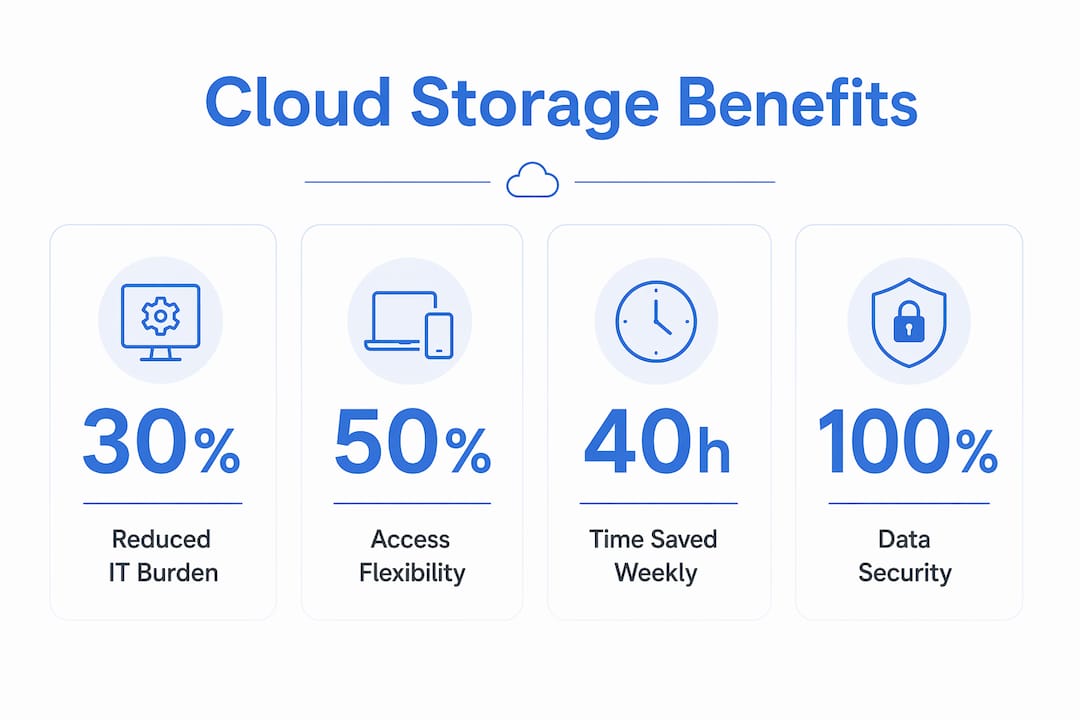
Cloud computing in education also reduces the IT operational burden significantly. When storage scales automatically and backups run without manual intervention, your IT team can redirect their time toward supporting teaching and learning rather than managing servers.
What are the core benefits of cloud storage in educational settings?
The cloud storage benefits for students and staff fall into five clear categories:
- Anywhere, anytime access. Students and teachers can retrieve and submit work from home, school, or a mobile device. This is particularly valuable for hybrid and remote learning arrangements.
- Real-time collaboration. Tools such as Microsoft 365 and Google Workspace allow multiple users to edit documents simultaneously. Online collaboration in UK schools is now used by 55% of teachers, reflecting how embedded this capability has become.
- Cost efficiency. Schools avoid the capital expenditure of physical servers and benefit from bulk licensing agreements. Costs shift from unpredictable hardware replacement cycles to predictable subscription models.
- Data security and disaster recovery. Cloud providers maintain redundant backups across multiple data centres. A fire, flood, or ransomware attack that destroys local hardware does not destroy cloud-held data.
- Scalability. A primary school and a multi-academy trust with 30 schools can both use the same cloud architecture. Storage expands as needs grow, without procurement delays.
Pro Tip: Request a data residency confirmation from your cloud provider before signing any contract. UK schools must know where their data is physically stored to comply with UK GDPR requirements.
How does cloud storage transform teaching and learning?
The pedagogical impact of cloud storage is best understood as a shift from static, one-off assessments to continuous, iterative learning cycles. Cloud-based learning environments enable a repeatable sequence: assignment, artefact creation, teacher feedback, student revision, and resubmission. Each step leaves a verifiable digital trace that teachers can review and act upon.

This matters because formative assessment works best when it is frequent and responsive. Cloud infrastructure makes that possible at scale. A teacher can annotate a student’s draft, return it within minutes, and track whether the student acted on the feedback. That level of traceability was simply not achievable with paper-based workflows.
Here is how a cloud-enabled learning workflow typically operates in practice:
- Assignment distribution. The teacher uploads a task to a cloud learning environment such as a virtual learning environment (VLE) or an interactive gradebook.
- Student completion. The student works on the task, saving progress automatically to the cloud. Version history is preserved.
- Artefact submission. The completed work is submitted digitally, timestamped, and stored securely.
- Teacher feedback. The teacher annotates the work directly within the platform and returns it to the student.
- Revision and resubmission. The student revises based on feedback. The teacher can compare versions to assess progress.
Pro Tip: Use the version history feature in Microsoft 365 or equivalent platforms to show students their own progress over time. Seeing concrete evidence of improvement is a powerful motivator.
This workflow supports better student outcomes by making learning visible, traceable, and responsive. The shift from static assessment to scaffolded, ongoing feedback is one of the most significant impacts of cloud technology on education.
What are the key challenges of implementing cloud storage in schools?
Technology alone does not guarantee success. Continuous communication, leadership support, and human readiness determine whether cloud adoption is sustainable. This is the most underestimated aspect of any cloud migration in a school setting.
The barriers schools most commonly encounter include:
- Resistance to change. Staff may worry that moving files to the cloud means losing control over their data, or that records will be deleted without warning. Clear communication about retention policies is non-negotiable.
- Digital literacy gaps. Not all teachers or support staff are equally confident with cloud tools. Without structured training, adoption becomes uneven and the benefits are not realised consistently.
- Governance complexity. Schools need standardised policies covering who can access what, how long data is retained, and what happens when a staff member leaves. Without these policies, cloud storage creates compliance risk rather than reducing it.
- Budgetary constraints. Smaller schools and those in multi-academy trusts with uneven IT capacity may struggle to fund both the technology and the training required for effective adoption.
- Infrastructure gaps. Reliable broadband is a prerequisite for cloud-dependent workflows. Schools in areas with poor connectivity face a genuine barrier that technology policy alone cannot resolve.
Understanding cloud-based school management as a socio-technical challenge, not just a technical one, is the first step toward addressing these barriers effectively.
How do data protection and compliance affect cloud storage in UK schools?
Data protection is the area where schools most frequently underestimate the complexity of cloud adoption. The Information Commissioner’s Office (ICO) enforces UK GDPR and the Data Protection Act 2018 across all educational institutions. Schools act as data controllers. Cloud providers act as data processors. That distinction carries significant legal weight.
The table below summarises the key compliance responsibilities:
| Responsibility | School (Data Controller) | Cloud Provider (Data Processor) |
|---|---|---|
| Defining purpose of data use | Yes | No |
| Signing a Data Processing Agreement | Yes | Yes |
| Ensuring technical security measures | Shared | Yes |
| Responding to Subject Access Requests | Yes | Supporting role |
| Data retention and deletion | Yes | As instructed |
Mapping data locations across cloud storage, backups, email systems, and third-party platforms is a statutory obligation, not a best-practice recommendation. Schools that cannot demonstrate where personal data is held, and for how long, face enforcement risk from the ICO.
Overseas cloud hosting adds another layer of complexity. If your provider stores data outside the UK or the European Economic Area, you must have appropriate transfer mechanisms in place. This is a common oversight when schools adopt consumer-grade cloud tools without proper procurement checks.
For practical guidance on data protection in online learning, reviewing your data processing agreements and retention schedules annually is the minimum standard expected by regulators.
What measurable impact does cloud adoption have on educational outcomes?
The evidence linking cloud computing adoption to improved academic performance is growing. Research published in 2026 confirms a positive correlation between cloud computing adoption and student academic performance in higher education. The study identifies perceived usefulness and ease of use as the two strongest predictors of adoption behaviour among both educators and learners. This means that if your staff find the tools difficult to use, the academic benefits will not materialise regardless of how sophisticated the technology is.
“Cloud-based learning environments support iterative learning cycles with digital traceability, enabling targeted feedback and scaffolding that static tools simply cannot replicate.” — Frontiers in Education, 2026
The operational benefits compound the academic ones. When cloud storage reduces the time teachers spend managing paperwork, printing resources, or chasing submitted work, that time transfers directly to teaching. Schools that have moved to cloud-based assessment workflows report that teachers spend less time on administration and more time on direct pupil interaction.
Equity is another measurable outcome. Cloud storage removes the physical barrier of the school building. A student without a printer at home can still submit work. A student recovering from illness can access lessons and resources without falling behind. The importance of cloud storage in schools extends to closing the access gap that has historically disadvantaged pupils from lower-income households.
Key takeaways
Cloud storage in education is most effective when it is treated as a governance and pedagogy tool, not merely a place to keep files.
| Point | Details |
|---|---|
| Centralise digital assets | Use cloud storage to consolidate student records, resources, and archives in one accessible, scalable location. |
| Enable iterative learning | Structure cloud workflows around assignment, feedback, and revision cycles to improve formative assessment. |
| Address human factors first | Invest in training and leadership engagement before deploying new cloud tools to avoid resistance and uneven adoption. |
| Map your data locations | Identify where personal data is held across all systems to meet UK GDPR obligations and reduce breach risk. |
| Measure adoption quality | Track whether staff find tools useful and easy to use, as these factors directly predict whether academic benefits are realised. |
Why schools should stop treating cloud storage as a filing cabinet
I have worked with enough schools to know that the most common mistake is treating cloud storage as a digital version of a filing cabinet. Files go in, files come out, and the technology is considered deployed. That approach wastes the majority of what cloud infrastructure actually offers.
The schools that see the strongest outcomes are the ones that redesign their workflows around the cloud rather than simply migrating existing paper processes into digital folders. When a teacher uses version history to show a student how their writing has improved over six weeks, that is cloud storage functioning as a pedagogical tool. When an IT manager uses automated retention policies to delete personal data after the statutory period, that is cloud storage functioning as a compliance tool. Neither of those outcomes happens by accident.
The compliance dimension is where I see the most anxiety, and rightly so. UK GDPR is not a checkbox exercise. Schools that treat data mapping as a one-time task rather than an ongoing process are the ones that end up in front of the ICO. The good news is that treating cloud as a governance architecture rather than simple storage makes compliance far more manageable. When your retention policies, access controls, and audit logs are built into the system, compliance becomes a by-product of normal operations rather than a separate burden.
My practical advice: start with a data map, build your governance policies before you migrate, and invest as much in training as you invest in the technology itself. The schools that do this well do not just avoid problems. They build a digital infrastructure that genuinely supports better teaching and learning for years to come.
— Ed
How Eschools supports your school’s cloud journey
Eschools has spent over 14 years helping UK schools and multi-academy trusts build digital infrastructure that is practical, compliant, and genuinely useful for staff and pupils. From cloud-based learning platforms to bespoke school websites and communication tools, Eschools designs solutions around the real operational needs of school leaders, not generic technology frameworks.

If you are ready to see how Eschools has helped schools like yours centralise their digital operations and improve outcomes, explore the Eschools portfolio of work for practical examples of cloud-enabled education in action. Whether you are an IT coordinator planning a migration or a headteacher reviewing your digital strategy, Eschools offers the expertise and support to make the transition straightforward.
FAQ
What is the main role of cloud storage in education?
Cloud storage in education centralises digital assets such as student records, learning resources, and multimedia archives, making them accessible to staff and pupils from any device. It also supports iterative learning workflows, data compliance, and scalable IT management.
Which cloud storage solutions are best for UK schools?
Microsoft 365 and Google Workspace are the most widely adopted platforms in UK schools, offering integrated storage, collaboration tools, and compliance features. The best choice depends on your existing IT infrastructure and the data residency requirements of your institution.
How does cloud storage support UK GDPR compliance in schools?
Schools must map all data locations, sign Data Processing Agreements with cloud providers, and implement clear retention and deletion policies to comply with UK GDPR. The ICO enforces these requirements and expects schools to demonstrate ongoing compliance, not just initial setup.
What are the biggest barriers to cloud adoption in schools?
Research identifies resistance to change, digital literacy gaps, governance complexity, and uneven IT capacity as the primary barriers. Addressing these requires structured training, clear communication, and active leadership support alongside the technology deployment.
How does cloud storage improve student outcomes?
Cloud storage enables iterative feedback cycles, expands access to learning materials outside school hours, and reduces administrative burden on teachers. Studies confirm a positive correlation between cloud computing adoption and improved academic performance, particularly when tools are perceived as useful and easy to use.