
TL;DR:
- Secure school communication uses encrypted, monitored channels to protect sensitive data and meet data protection laws. It involves tools with logging, role-based permissions, and multi-channel messaging to ensure safety and compliance. Effective policies and cultural change are essential to prevent informal messaging practices from creating vulnerabilities.
Secure school communication is defined as the use of designated, encrypted, and monitored channels to exchange information between staff, students, and parents within an educational institution. The term covers everything from encrypted messaging platforms to mass notification systems, and it sits at the intersection of data protection law, safeguarding duty, and operational efficiency. In the UK, schools must align their communication practices with the UK GDPR and the Data Protection Act 2018, while international frameworks such as FERPA and HIPAA set comparable standards elsewhere. Getting this right is not optional. A single data breach involving pupil records or a delayed emergency alert can carry serious legal and reputational consequences for your school.
What is secure school communication and why does it matter?
Secure school communication means every message sent within your institution travels through a channel that is encrypted, logged, and accessible only to authorised users. The industry term for this broader practice is unified secure communications, and it combines technical controls with governance policies to protect sensitive data. Compliance standards such as FERPA and HIPAA require that platforms log communications, enable parental access, and enforce role-based permissions. That requirement exists because schools handle some of the most sensitive personal data in any sector, including medical records, safeguarding notes, and behavioural histories.
The stakes are higher than many school leaders realise. When a teacher texts a parent from a personal mobile, that conversation sits outside any audit trail. If a complaint arises or a safeguarding concern is later questioned, there is no institutional record to consult. Secure channels solve this by keeping every exchange within a managed environment where administrators can review, retrieve, and act on records when needed.
What secure communication tools for schools actually do
The foundation of any secure school communication system is AES-256 encryption, the same standard used by government agencies and financial institutions. Every message is scrambled in transit and at rest, meaning that even if data is intercepted, it cannot be read without the correct decryption key. Platforms that meet this standard store messages in secure cloud archives that administrators can access for compliance oversight.
Beyond encryption, effective tools share several defining features:
- District-owned or school-managed numbers. Rather than using personal mobile numbers, staff communicate through a school-assigned number on their own device. This separates professional and personal communications, reduces liability, and means the number stays with the school when a member of staff leaves.
- Full message logging and archiving. Every sent and received message is recorded. Administrators can retrieve records for FERPA or HIPAA compliance reviews, parental access requests, or internal investigations.
- Multi-factor authentication (MFA). Staff must verify their identity through a second step before accessing the platform, reducing the risk of unauthorised access.
- Unified channels. The best platforms combine voice, SMS, chat, video, and file sharing in one place. Cloud-based unified platforms reduce the temptation to use unsanctioned apps by making the secure option the most convenient one.
- Role-based permissions. A class teacher sees only what is relevant to their pupils. A headteacher or designated safeguarding lead has broader access. Permissions are set by the institution, not the individual.
Pro Tip: When evaluating platforms, ask vendors specifically whether message archives are stored in UK data centres and whether the platform holds ISO 27001 certification. Both matter for UK GDPR compliance.
Schools can also reduce communication costs by over 50% when switching from cellular stipends or district-issued devices to managed secure messaging apps on personal phones. That saving alone often justifies the investment in a proper platform.

How does secure communication support school safety and crisis management?
Secure communication is the backbone of any credible school safety plan. When an incident occurs, whether a fire, a lockdown, or a medical emergency, the speed and accuracy of your messaging directly affects outcomes. Pre-planned emergency templates and tested workflows remove the guesswork from high-pressure moments, ensuring the right message reaches the right people within seconds.
A well-designed crisis communication system works in layers:
- Pre-approved message templates. Draft and approve messages for common scenarios before any incident occurs. Templates for lockdowns, evacuations, and medical emergencies should be reviewed by your senior leadership team and legal adviser annually.
- Multi-channel mass notification. Mass notification tools send alerts simultaneously via SMS, email, app push notifications, and voice calls. No parent or staff member is missed because they happen not to check one channel.
- Escalation and approval workflows. Define who authorises each type of message before a crisis happens. A deputy headteacher might approve routine alerts; the headteacher or a designated governor approves lockdown communications.
- Coordination with first responders. Secure platforms can include dedicated channels for police, fire, and ambulance services, keeping external responders informed without exposing sensitive pupil data to unauthorised parties.
- Post-incident audit. Every message sent during a crisis is logged with a timestamp. This record supports your post-incident review, Ofsted scrutiny, and any legal proceedings.
“Preparedness in crisis communication is not a luxury. Schools that routinely test communication plans and templates ensure clarity and speed under pressure, limiting misinformation and panic. Improvising during a live incident slows response and increases risk to pupils and staff.”
Transparency with parents during and after an incident builds lasting trust. A school that communicates clearly and promptly, even when the news is difficult, demonstrates the kind of leadership that communities remember.
What organisational policies sustain secure communication in schools?
Technology alone does not make communication secure. Organisational culture is equally critical, and this is where many schools fall short. A platform with AES-256 encryption provides no protection if staff continue to text parents from personal mobiles because it feels more convenient.
The policies that make the biggest difference include:
- A strict no-personal-device policy for school messaging. Every member of staff, from the headteacher to the lunchtime supervisor, must use only school-managed channels for any communication related to pupils, parents, or colleagues. This policy must be written into contracts and staff handbooks.
- Regular training and awareness sessions. Staff need to understand why the policy exists, not just that it does. Training should cover real examples of what can go wrong when personal devices are used, including data breaches, safeguarding failures, and disciplinary consequences.
- Digital identity reassignment. When a teacher leaves, their school-managed number and communication history stays with the institution. This preserves institutional knowledge and ensures continuity for parents who have an ongoing relationship with the school.
- Audit trail obligations. School leaders carry a legal and moral duty to maintain records of communications involving pupils. Audit trails are not bureaucratic overhead. They are your evidence base if a safeguarding concern is ever challenged.
- Balancing compliance with usability. The most common reason staff bypass secure systems is friction. If the approved platform is slow or difficult to use, people will default to WhatsApp. Choose tools that are genuinely easy to use, then enforce the policy consistently.
Pro Tip: Run a short annual survey asking staff which communication tools they actually use day-to-day. The results often reveal shadow communication habits that your policy has not yet addressed.
Practical steps to implement secure communication in your school
Moving from informal to fully secure communication does not happen overnight, but a structured approach makes it manageable. The table below outlines the key implementation stages and what each involves.
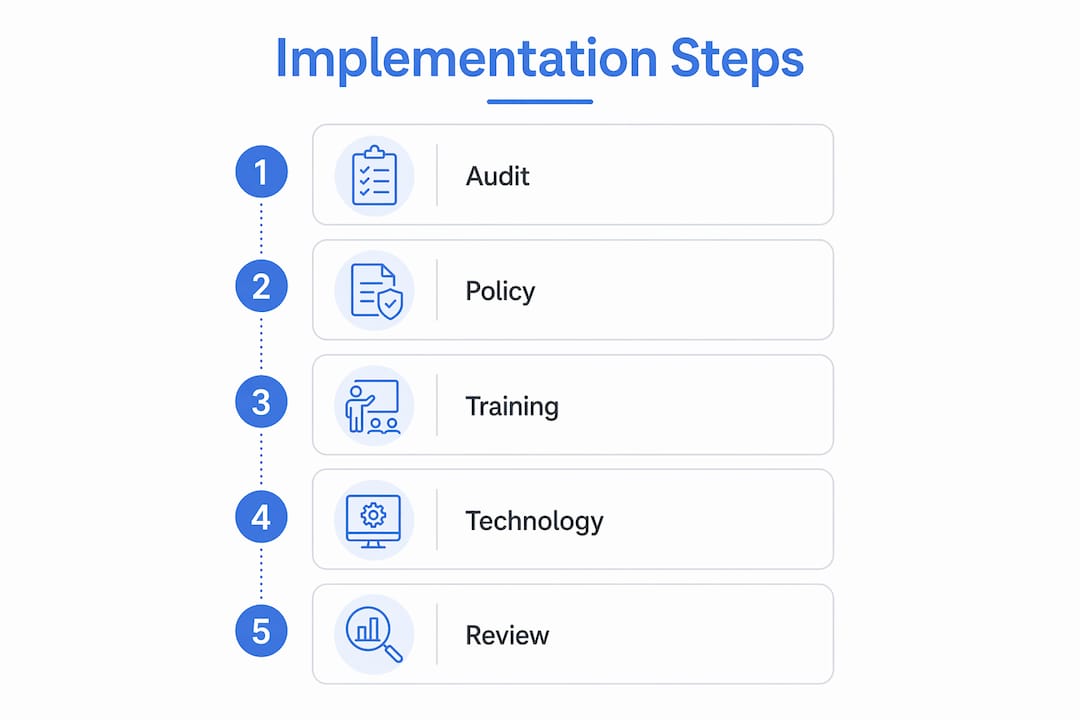
| Stage | Action | Outcome |
|---|---|---|
| Audit current practice | Map all channels staff currently use, including personal mobiles and consumer apps | Identifies gaps and compliance risks |
| Select a platform | Evaluate cloud-based tools against UK GDPR, encryption standards, and usability | Ensures legal compliance and staff adoption |
| Involve stakeholders | Consult governors, staff, and parent representatives during planning | Builds buy-in and surfaces practical concerns |
| Train all staff | Deliver role-specific training before go-live | Reduces errors and policy breaches |
| Test crisis workflows | Run termly drills using your mass notification templates | Confirms the system works under pressure |
| Review and improve | Conduct an annual review of platform use, policy compliance, and incident logs | Keeps your approach current and effective |
Involving governors early is particularly valuable. Governors carry strategic oversight responsibility for safeguarding and data protection, so their endorsement of a new communication policy carries weight with staff. Parent portals and school apps also play a role here, giving families a secure, school-managed channel for routine updates, appointment bookings, and consent forms. When parents communicate through a managed portal rather than a teacher’s personal email, every exchange is logged and protected.
For multi-academy trusts, the implementation challenge is greater but the benefits are proportionally larger. A unified communication approach across all schools in a trust creates consistent compliance standards, shared audit trails, and economies of scale in licensing costs.
Key takeaways
Secure school communication requires encryption, policy, and culture working together. Technology without governance leaves critical gaps, and governance without usable tools creates workarounds that undermine the entire system.
| Point | Details |
|---|---|
| Encryption is the baseline | AES-256 encryption protects messages in transit and at rest, meeting FERPA and HIPAA standards. |
| Policy must match technology | A no-personal-device policy, written into staff contracts, is as important as the platform itself. |
| Crisis plans need testing | Pre-approved templates and termly drills ensure fast, accurate messaging when it matters most. |
| Digital identities protect continuity | School-managed numbers stay with the institution when staff leave, preserving records and relationships. |
| Cost savings are real | Switching to managed messaging platforms can cut communication costs by over 50% versus device stipends. |
Why I think schools underestimate the culture problem
Most conversations about secure school communication focus on the technology, and understandably so. Encryption standards, platform features, and compliance certifications are concrete and measurable. But in my experience observing how schools actually operate, the technology is rarely the weak link.
The real vulnerability is the group chat. A year group’s teaching team creates a WhatsApp group because it is fast and familiar. A parent gets added by mistake. A message about a pupil’s behaviour is screenshotted and shared. None of this is malicious. It is simply what happens when convenience wins over compliance, and when staff have not been given a genuinely usable alternative.
The schools that get this right do two things consistently. They choose platforms that are at least as easy to use as the consumer apps they are replacing. And they talk openly with staff about the why, not just the what. When a teacher understands that using a personal number to contact a parent creates a safeguarding record that the school cannot access or defend, the policy stops feeling like bureaucracy and starts feeling like protection.
The shift towards integrated, cloud-based communication is making this easier. Platforms that combine messaging, notifications, and parent engagement in one place reduce the friction that drives people back to WhatsApp. The technology is now good enough. The remaining work is cultural, and that is squarely the responsibility of school leadership.
— Ed
How Eschools supports secure school communication
Eschools has spent over 14 years helping UK schools and multi-academy trusts build digital environments that are compliant, effective, and genuinely easy to manage. Their communication tools are designed with school leaders in mind, covering everything from parent engagement apps to MAT-wide website solutions that keep all communication within auditable, school-managed channels.

If you are reviewing your school’s communication approach, the Eschools platform shows how schools across the UK have moved from fragmented, informal messaging to structured, compliant systems. The results include stronger parent relationships, clearer audit trails, and measurable cost savings. Speak to the Eschools team to find out which tools fit your school’s specific needs.
FAQ
What is secure school communication?
Secure school communication is the practice of using encrypted, monitored, and school-managed channels to exchange information between staff, parents, and pupils. It replaces informal tools like personal mobile messaging with platforms that log every interaction for compliance and safeguarding purposes.
Why can’t teachers just use WhatsApp or personal mobiles?
Personal devices and consumer apps sit outside any institutional audit trail. If a safeguarding concern or complaint arises, the school has no access to those records. UK GDPR also requires that personal data is processed through controlled, documented systems.
What encryption standard should a school communication platform use?
AES-256 encryption is the recognised standard for secure school messaging. It protects message content in transit and in storage, and it meets the requirements of FERPA, HIPAA, and UK data protection legislation.
How do schools communicate securely during a crisis?
Effective crisis communication relies on pre-approved message templates, multi-channel mass notification tools, and clear escalation workflows. Schools that test these plans through regular drills respond faster and more accurately when a real incident occurs.
What happens to communication records when a teacher leaves?
With school-managed numbers and platforms, the communication history and the assigned number remain with the institution. This protects continuity, preserves the audit trail, and means parents are not left without a point of contact during staff transitions.