
TL;DR:
- Parent portals provide parents with secure, real-time access to their child’s grades, attendance, and schedules. They improve communication by offering instant updates and direct messaging, fostering closer home-school relationships. Parents should use portals actively as planning tools and avoid constant grade checking to support student independence.
A parent portal is a secure online gateway that gives you real-time access to your child’s grades, attendance, schedules, and payments, all in one place. These centralised digital dashboards connect directly to a school’s Student Information System (SIS), replacing paper notices and fragmented emails with instant self-service access. Platforms like Infinite Campus and PowerSchool have made this model standard across thousands of schools. The role of parent portals goes well beyond convenience. They are the primary digital link between home and school, and understanding how to use them well makes a real difference to your child’s education.
How do parent portals improve communication and parental engagement?
Parent portals remove the communication delays that once defined school life. Before portals, you waited for a letter home, a phone call, or a parents’ evening to find out how your child was doing. Now, that information is available the moment a teacher updates it.
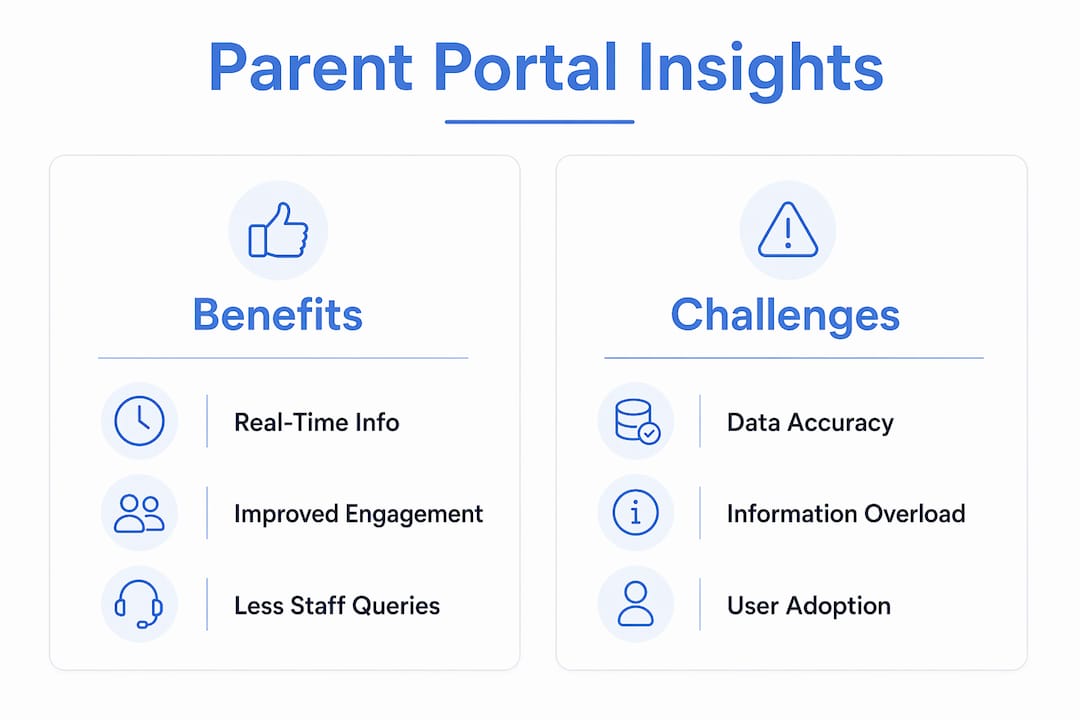
The benefits of parent portals for day-to-day communication are clear:
- Instant access to grades and attendance means you can spot a problem early, before it becomes a pattern.
- Direct messaging tools let you contact a teacher without going through the school office.
- Payment and consent systems are handled in one place, reducing the chance of missed trips or unpaid dinner money.
- Schedule and timetable visibility helps you plan around your child’s school week with confidence.
Portals reduce routine queries for school staff by giving parents a single source for key information. Fewer emails and phone calls to the office means teachers and administrators can focus on what matters most. That is a genuine benefit for everyone.
Pro Tip: Set up notification preferences in your portal so you receive alerts for the updates that matter most to you, such as attendance marks or new messages, rather than every minor change.

The importance of school portals also shows up in trust. When parents can see accurate, up-to-date information, they are less likely to feel anxious or left out. Transparency builds confidence in the school, and that confidence supports a healthier relationship between home and school.
How do portal features differ across primary and secondary school?
Parent portals are not one-size-fits-all. The features and access levels schools offer vary significantly by student age, and for good reason.
| Feature | Primary school portals | Secondary school portals |
|---|---|---|
| Main focus | Daily logistics and teacher messages | Academic progress and student autonomy |
| Grade visibility | Broad, frequent updates | Controlled, often delayed release |
| Student access | Rarely given direct access | Students often have their own login |
| Communication style | Parent-to-teacher led | Three-way: parent, student, and teacher |
| Parental visibility | High, covering most school activity | Selective, respecting growing independence |
At primary level, portals emphasise logistical communication. You want to know about the school trip, the reading record, and whether your child was marked present. The portal handles all of this efficiently.
At secondary level, the picture changes. Schools begin to balance transparency with student independence, which means you may not see every grade the moment it is entered. Some schools release results in batches, or give students the option to view their own data first. This is a deliberate policy choice, not a technical limitation. It reflects the school’s goal of encouraging your teenager to take ownership of their own learning.
Understanding this distinction helps you use the portal more effectively. At secondary level, the portal works best as a starting point for conversation with your child, not as a surveillance tool.
What challenges can arise from using parent portals?
The benefits of parent portals are real, but so are the risks when they are used without boundaries. Constant grade checking can increase student stress and create unhealthy academic pressure. Experts advise focusing on the learning process rather than fixating on scores. That advice is harder to follow when grades update in real time.
Common challenges parents face with portals include:
- Information overload. Too many notifications can make it difficult to identify what actually needs your attention.
- Data accuracy delays. School-side entry delays mean the data you see may not reflect the current picture. A missing grade is often an admin lag, not a cause for alarm.
- Helicopter parenting dynamics. Checking the portal multiple times a day can undermine your child’s sense of independence and responsibility.
- Technical access barriers. Parents without reliable internet access or digital confidence may struggle to use portals effectively, creating an engagement gap.
Pro Tip: Rather than checking the portal daily, set a fixed time each week to review it with your child. This turns portal use into a shared planning habit rather than a source of anxiety for either of you.
Schools carry responsibility here too. Maintaining accurate, current contact data is critical for urgent notifications to reach the right people. If your details are out of date, you may miss time-sensitive alerts. Check your contact information in the portal at the start of each academic year and update it whenever your circumstances change.
The challenges of parent portals are manageable with the right habits. The portal is a tool. Like any tool, its value depends entirely on how you use it.
How do parent portals fit into a school’s wider engagement strategy?
Parent portals work best as part of a broader digital ecosystem, not as a standalone product. Schools that rely on portals alone risk leaving parents hunting across disconnected systems for different types of information. The most effective schools combine portals with apps, email communications, school websites, and parent evening booking systems to create a joined-up experience.
A well-integrated approach to parental engagement looks like this:
- A central portal provides real-time academic data: grades, attendance, and timetables.
- A school website hosts key policies, term dates, newsletters, and statutory information.
- A mobile app delivers push notifications for urgent updates and direct messages.
- A parents’ evening booking system removes the friction from scheduling face-to-face meetings.
- Email and SMS communications reach parents who prefer traditional channels or lack app access.
When these tools share consistent information, parents stop feeling confused. They know where to look and what to expect. That consistency is what drives sustained engagement over time.
Portal data also supports early intervention. Engagement indicators such as portal logins and responses to attendance notifications help schools identify families who may be disengaging before the situation becomes serious. A parent who stops logging in is a signal worth acting on. Schools that use this data proactively improve both attendance and retention.
| Engagement signal | What it may indicate | Recommended school response |
|---|---|---|
| No portal logins for 4+ weeks | Parent disengagement or access barrier | Direct outreach by phone or letter |
| Unread attendance notifications | Possible contact detail issue | Verify and update parent contact records |
| No response to consent requests | Communication breakdown | Follow up via alternative channel |
Using parent portals for academic tracking is most effective when the school treats portal activity as a two-way signal, not just a data broadcast. You engage with the portal; the school notices and responds. That loop is what makes the technology genuinely useful for parental involvement in education.
Pro Tip: If your school offers a mobile app alongside the portal, use both. The app is better for urgent alerts; the portal is better for reviewing detailed academic data at your own pace.
Successful portal adoption also depends on schools providing clear guidance to parents at the point of onboarding. A portal that parents cannot navigate confidently will not be used. Schools that invest in short video guides, welcome emails, and helpdesk support see significantly higher engagement rates. If your school has not provided this, ask for it. You are entitled to understand the tools available to you.
Key takeaways
Parent portals are most effective when used as active communication and planning tools, not as passive grade-checking dashboards.
| Point | Details |
|---|---|
| Portals connect home and school | They link directly to the school SIS, giving you real-time access to grades, attendance, and payments. |
| Features vary by age group | Primary portals focus on logistics; secondary portals prioritise student autonomy with controlled parental access. |
| Overuse carries real risks | Constant grade checking increases student stress; set a weekly review routine instead. |
| Portals work best in a wider system | Combined with apps, websites, and email, portals create a joined-up engagement experience. |
| Data accuracy requires both sides | Keep your contact details current, and allow for school-side entry delays before raising concerns. |
Why I think most parents are using portals the wrong way
Most parents I speak with treat the portal as a scoreboard. They log in to check grades, feel relieved or worried, and log out again. That is understandable. The portal makes grades visible, so grades become the focus. But that is not what the technology is designed for.
Using portals as active planning tools with your child, reviewing upcoming deadlines together, checking what is due next week, is far more effective than passive monitoring. The research supports this. The parents who get the most from portals are the ones who sit down with their child and use the data as a conversation starter, not a verdict.
The other thing I would push back on is the assumption that more access is always better. At secondary level especially, your teenager needs to develop their own relationship with their academic progress. If you are checking their portal more often than they are, something has gone wrong. The goal is to support independence, not replace it. A good school portal, used well, helps you do exactly that.
— Ed
Eschools and parent engagement platforms for UK schools
Eschools has supported UK schools for over 14 years, building bespoke school websites that integrate parent portals, communication tools, and online learning platforms into a single, manageable system.
Whether your school needs a parent-facing portal that connects to your SIS, a parents’ evening booking system, or a full digital engagement solution for a multi-academy trust, Eschools has the tools and the experience to make it work. The platform is designed to be straightforward for school staff to manage and easy for parents to use. You can see examples of Eschools’ work across UK schools at our work page. If your school is looking to improve how it communicates with families, Eschools is a practical starting point.
FAQ
What is the main role of parent portals in schools?
Parent portals give parents secure, real-time access to their child’s grades, attendance, timetables, and payments through a single digital platform linked to the school’s Student Information System. Their primary role is to replace fragmented communications with a reliable, self-service information source.
How do parent portals improve communication between parents and teachers?
Portals provide direct messaging tools and instant data updates, reducing the need for phone calls and letters. This gives parents timely information and allows teachers to focus on teaching rather than routine administrative queries.
Are parent portals suitable for all age groups?
Yes, but the features differ. Primary school portals focus on daily logistics and teacher messages, while secondary school portals balance parental visibility with student autonomy, often giving students their own login and controlling when grades are released.
What are the biggest challenges of parent portals?
The main challenges include data accuracy delays caused by school-side entry lags, information overload from too many notifications, and the risk of excessive grade monitoring increasing student stress. Setting a weekly review routine and keeping contact details current addresses most of these issues.
How can parents get the most from a school parent portal?
Use the portal actively by reviewing upcoming deadlines with your child rather than checking grades alone. Combine portal use with the school’s app and email communications for a complete picture of your child’s school life.