
TL;DR:
- Secure student portals protect sensitive data with layered security features like MFA and role-based access. They also enhance communication, streamline workflows, and build parental trust through controlled, secure access. Leadership involvement in governance and regular audits are essential for maintaining long-term system security.
Secure student portals are specialised digital platforms that protect sensitive student information while enabling effective communication between schools, students, and parents. Understanding why use secure student portals matters is no longer optional for school leaders. A single breach can expose thousands of records, disrupt learning, and trigger regulatory penalties under frameworks such as the UK GDPR. The most effective portals combine multi-factor authentication (MFA), role-based access control (RBAC), and end-to-end encryption to create a layered defence that keeps student data safe and school operations running.
Why use secure student portals: the core security case
Secure student portals are not simply password-protected websites. They are purpose-built environments where every layer of access is controlled, logged, and audited. Industry best practices for student data security include role-based access, MFA, end-to-end encryption, third-party vendor security reviews, and incident response planning. Each of these features addresses a specific attack surface that generic platforms leave exposed.

The importance of secure student portals becomes clear when you examine what they protect. Student Information Systems (SIS) hold names, addresses, medical notes, attendance records, and safeguarding flags. A breach of this data does not just embarrass a school. It can harm children directly and expose the institution to enforcement action from the Information Commissioner’s Office.
Protecting student and parent data is no longer just an IT issue. It is a core duty of care with direct effects on trust and school operation continuity. School leaders who treat portal security as a technical afterthought are misreading both the risk and their legal responsibility.
What are the key security features of secure student portals?
The benefits of secure student portals depend entirely on the quality of the features underneath them. Weak implementation of even one layer can undo the rest.
The non-negotiable features are:
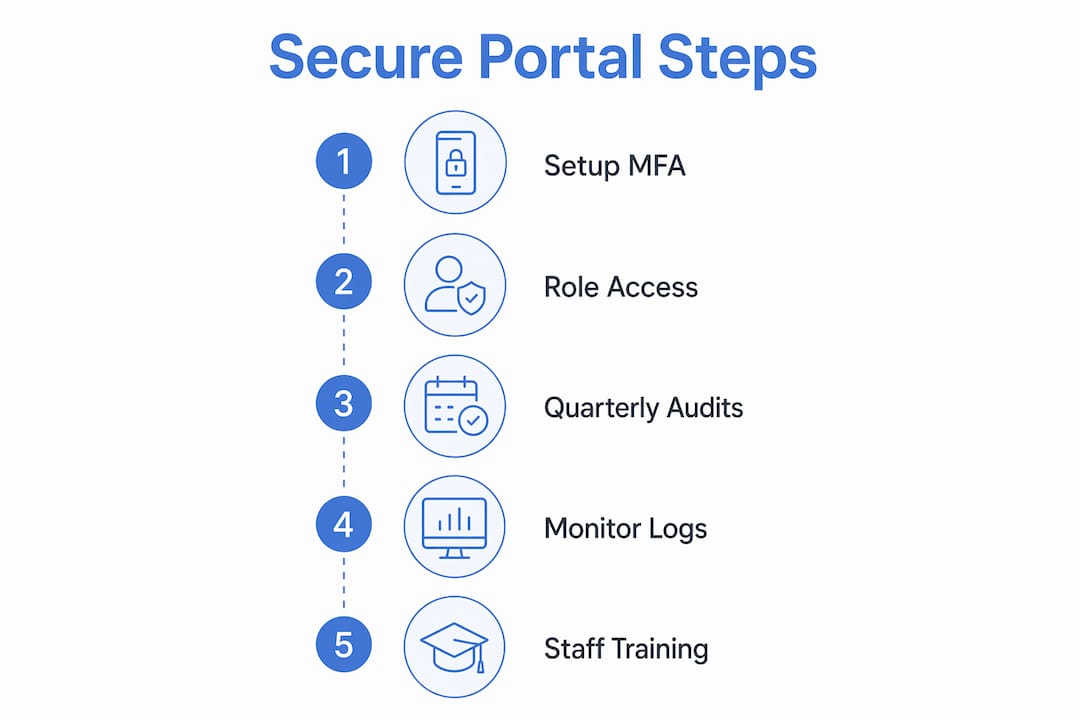
- Role-based access control (RBAC): Each user sees only the data their role requires. A form tutor does not need access to finance records. A parent sees their child’s data only. RBAC enforces this automatically.
- Multi-factor authentication (MFA): MFA requires users to verify identity through two or more methods. This single control would have prevented many of the most damaging breaches recorded in education.
- End-to-end encryption: Data encryption via SSL certificates, encrypted APIs, and secure cloud infrastructure prevents interception during transmission and at rest.
- Adaptive authentication: Systems that detect login anomalies go beyond static passwords. Flagging a login attempt from an unusual country or an unrecognised device fingerprint adds a dynamic layer of protection that static credentials cannot provide.
- Regular security audits and vendor reviews: Third-party vendors with access to your systems must be held to the same standards as internal staff. Contracts should mandate security reviews and define what happens when a vendor’s credentials are compromised.
- Incident response planning: A written, tested plan for responding to a breach reduces damage significantly. Schools without one tend to discover the gap only after an incident has already escalated.
Pro Tip: Run a quarterly access audit. Remove accounts for staff who have left and review whether current permissions still match current roles. This single habit closes one of the most common vulnerabilities in school portals.
How do secure student portals mitigate risks related to student data breaches?
The risks that secure portals guard against are concrete and well-documented. Failure to implement MFA and failure to detect unauthorised activity for over four months resulted in millions of compromised student records in a case investigated by the Information and Privacy Commissioner of Ontario. That is not a theoretical scenario. It is a documented failure with real consequences for real children.
“Misuse of third-party or subcontractor credentials is a critical vulnerability that can allow prolonged unauthorised access if MFA and log policies are not enforced. In one documented case, a breach persisted undetected for four months due to weak controls over third-party access.”
Information and Privacy Commissioner of Ontario
The mechanism behind many breaches is not a sophisticated cyberattack. It is poor permission management. Role-based access control misconfiguration is a primary vulnerability in student portals, risking unintended data exposure to students or parents. A parent who can view another child’s record, or a student who can access a teacher’s gradebook, represents a misconfiguration that should never reach a live system.
Proactive monitoring and log retention are equally critical. Without audit trails, you cannot determine what was accessed, by whom, or for how long. This makes regulatory reporting after a breach far harder and can increase the severity of any penalty. Schools that maintain detailed logs and review them regularly catch anomalies before they become incidents. The security in online learning context makes this even more pressing, as remote access increases the number of potential entry points into your systems.
Why are secure student portals critical for communication and efficiency?
The advantages of using student portals extend well beyond data protection. A well-configured portal centralises resources, communication channels, and administrative workflows into a single, controlled environment. This reduces the risk of sensitive information being shared through insecure channels such as personal email or messaging apps, which remain common in schools without a dedicated platform.
The operational benefits for school administrators are significant:
- Centralised communication: Staff, students, and parents access updates, documents, and messages through one authenticated channel. This removes the fragmentation that creates both security gaps and administrative overhead.
- Controlled data access: Parents see what they need to see, nothing more. This transparency builds trust while keeping sensitive records protected. Parent portals in school communication demonstrate how structured access improves engagement without compromising privacy.
- Secure remote and mobile access: Staff and students working off-site need the same level of protection as those on the school network. A secure portal with MFA and encrypted connections delivers this without requiring a VPN or complex IT configuration.
- Streamlined administrative workflows: Attendance, reporting, and parental consent processes handled through a secure portal reduce paper handling and manual data entry. This cuts the risk of human error introducing inaccuracies into student records.
- Parental engagement at scale: Schools using mobile app solutions for parent communication report faster response rates and higher engagement with school communications than those relying on letters or unencrypted email.
The school communication software benefits are inseparable from the security architecture. A portal that is easy to use but insecure creates risk. One that is secure but difficult to use gets abandoned. The goal is both.
What practical steps can educational leaders take to implement secure portals?
Implementation is where good intentions either succeed or fail. The following comparison shows the difference between a reactive approach and a proactive one.
| Area | Reactive approach | Proactive approach |
|---|---|---|
| Access management | Remove accounts when reported | Audit all accounts quarterly |
| Vendor oversight | Trust vendor’s own assurances | Require contractual security standards |
| Breach response | Improvise when an incident occurs | Maintain a tested incident response plan |
| Authentication | Single password login | MFA enforced for all user types |
| Monitoring | Review logs after a complaint | Continuous monitoring with anomaly alerts |
A proactive commitment to continuous monitoring and data consent policies is crucial for maintaining long-term institutional credibility and compliance. This is not a one-off project. It is an ongoing operational discipline.
Staff training is the element most frequently underestimated. Technical controls only work if the people using the system understand why they exist. A member of staff who shares login credentials because MFA feels inconvenient has bypassed every technical safeguard in place. Training should cover access management, recognising phishing attempts, and the correct procedure for reporting a suspected breach.
Penetration testing, conducted at least annually by an independent party, reveals vulnerabilities that internal reviews miss. Many schools assume their portal is secure because it has not been breached. Absence of a known breach is not evidence of security. It may simply mean the breach has not been detected yet, as the Ontario case demonstrated clearly.
Pro Tip: When procuring any edtech platform, request the vendor’s most recent security audit report and ask specifically how they manage subcontractor access. Vendors who cannot answer this question clearly represent a risk.
Security failures in schools are systemic risks that impact operations and regulatory compliance. Treating data protection as a core duty of care, rather than an IT task, is the shift that separates schools with strong security cultures from those that are one breach away from a crisis.
Key takeaways
Secure student portals protect student data and improve school communication only when security is treated as an ongoing operational priority, not a one-off technical project.
| Point | Details |
|---|---|
| MFA is non-negotiable | Portals without multi-factor authentication are vulnerable to credential-based breaches lasting months. |
| RBAC prevents data leakage | Role-based access control stops users from seeing data outside their permitted scope. |
| Vendor access is a critical risk | Third-party credentials must be governed by contractual security standards and mandatory MFA. |
| Proactive monitoring beats reactive fixes | Continuous audit trails and anomaly detection catch breaches before they escalate. |
| Security enables communication | A secure portal centralises communication and builds the trust that drives parental engagement. |
Security is a governance question, not just an IT one
I have spent years watching schools invest in digital platforms and then hand governance of those platforms entirely to their IT coordinator. That is the wrong model. When a breach occurs, it is the headteacher and governors who face the ICO, the press, and the parents. The people accountable for the outcome must be involved in the decisions that shape it.
The schools I have seen handle security well share one characteristic: their leadership team asks hard questions. They want to know who has access to what, how vendor contracts are structured, and what the incident response plan actually says. They do not assume that because a platform is cloud-based it is automatically secure. They treat security as part of their duty of care to children, which is exactly what it is.
The uncomfortable truth is that most breaches are preventable. They happen because of delayed account removal, unmonitored third-party access, or MFA that was never switched on. None of these are sophisticated failures. They are governance failures. The technology to prevent them exists. What is often missing is the leadership commitment to use it consistently.
Security is not a destination. It is a discipline. Schools that build it into their governance cycle, their procurement decisions, and their staff training programmes are the ones that maintain the trust of parents and the confidence of regulators. That is worth more than any single feature a portal vendor can offer.
— Ed
How Eschools supports secure digital engagement in UK schools
Eschools has supported UK schools and multi-academy trusts for over 14 years, building digital platforms that put communication and compliance at the centre. The Eschools approach combines user-friendly design with the security architecture that school leaders need, including controlled access, encrypted communications, and tools that keep parents, staff, and students connected through authenticated channels.
Whether you are reviewing your current portal setup or planning a new digital strategy, the Eschools portfolio of work shows how schools across the UK have built secure, effective digital environments. From school websites designed for engagement and compliance to communication tools that replace insecure email chains, Eschools provides the infrastructure that makes secure student portals practical, not just possible. Speak to the Eschools team to find out how the platform can support your school’s security and communication goals.
FAQ
What is a secure student portal?
A secure student portal is a password-protected, encrypted digital platform that gives students, parents, and staff controlled access to school information. Access is governed by role-based permissions and, in well-configured systems, multi-factor authentication.
How secure are student portals in practice?
Security depends on implementation. Portals with MFA, RBAC, encrypted connections, and regular audits offer strong protection. Those without these controls are vulnerable, as documented cases of breaches persisting undetected for months confirm.
What are the main benefits of secure student portals for schools?
The primary benefits include protected student data, reduced risk of regulatory penalties, centralised communication, and improved parental engagement through authenticated, controlled access channels.
Why are student portals safe when using role-based access control?
Role-based access control limits each user to the data their role requires. This prevents accidental or deliberate exposure of sensitive records to users who have no legitimate need to see them.
What should school leaders check when choosing a secure portal provider?
Request the vendor’s most recent independent security audit, confirm how subcontractor access is managed, and verify that MFA is enforced by default rather than offered as an optional setting.