
TL;DR:
- Parental engagement involves active two-way collaboration between families and schools, supporting children’s learning. It leads to significant academic gains, including an average of four months’ progress per year, and improves attendance, behavior, and wellbeing. Building lasting engagement requires sustained effort, strategic use of digital tools, and targeted responses to various barriers.
Parental engagement is defined as the active, two-way collaboration between parents, educators, and communities that directly supports a child’s learning and development. Unlike simple parental involvement, which often means attending events or signing permission slips, true engagement requires parents to participate in shaping their child’s education as genuine partners. The Education Endowment Foundation reports that effective parental engagement can deliver an average of four months’ additional academic progress per year, primarily in literacy and maths. That figure alone makes the case for treating family engagement as a school priority, not an afterthought. Eschools has worked with UK schools for over 14 years and seen first-hand how the quality of parent-school communication determines whether engagement is real or merely performative.
What is parental engagement and how does it differ from involvement?
Parental engagement is not the same as parental involvement, and the distinction matters enormously in practice. Involvement describes passive participation: attending a parents’ evening, returning a consent form, or reading a newsletter. Engagement, by contrast, requires two-way communication where families actively contribute to decisions about their child’s education rather than simply receiving information. The direction of communication is the defining test. If the school broadcasts and parents receive, that is involvement. If parents respond, question, and co-create, that is engagement.

The academic literature reinforces this distinction. Research published in the International Journal of Parental Engagement identifies parental engagement as a multi-faceted set of behaviours spanning home learning environments, communication with educators, participation in school events, and the transmission of educational values. Each of these behaviours operates differently depending on the child’s age, the school’s culture, and the family’s circumstances. No single activity defines engagement on its own.
Understanding this distinction shapes how schools design their communication strategies. A school that sends weekly newsletters but never asks for parent input is not engaging families. A school that creates structured opportunities for parents to contribute to curriculum decisions, behaviour policies, or school improvement plans is building genuine partnership.
How does parental engagement influence children’s academic and wellbeing outcomes?
The evidence base for parental engagement is strong and consistent. The Education Endowment Foundation’s Teaching and Learning Toolkit places parental engagement among the highest-impact interventions available to schools, with the four months’ additional progress figure drawn from a broad review of international studies. The gains are most pronounced in literacy and maths, but the benefits extend well beyond test scores.
Children with engaged parents show better attendance, more positive classroom behaviour, and stronger social and emotional development. These outcomes compound over time. A child who arrives at secondary school with a strong home learning environment and a parent who communicates regularly with teachers is better placed to manage academic pressure, build resilience, and set realistic goals.
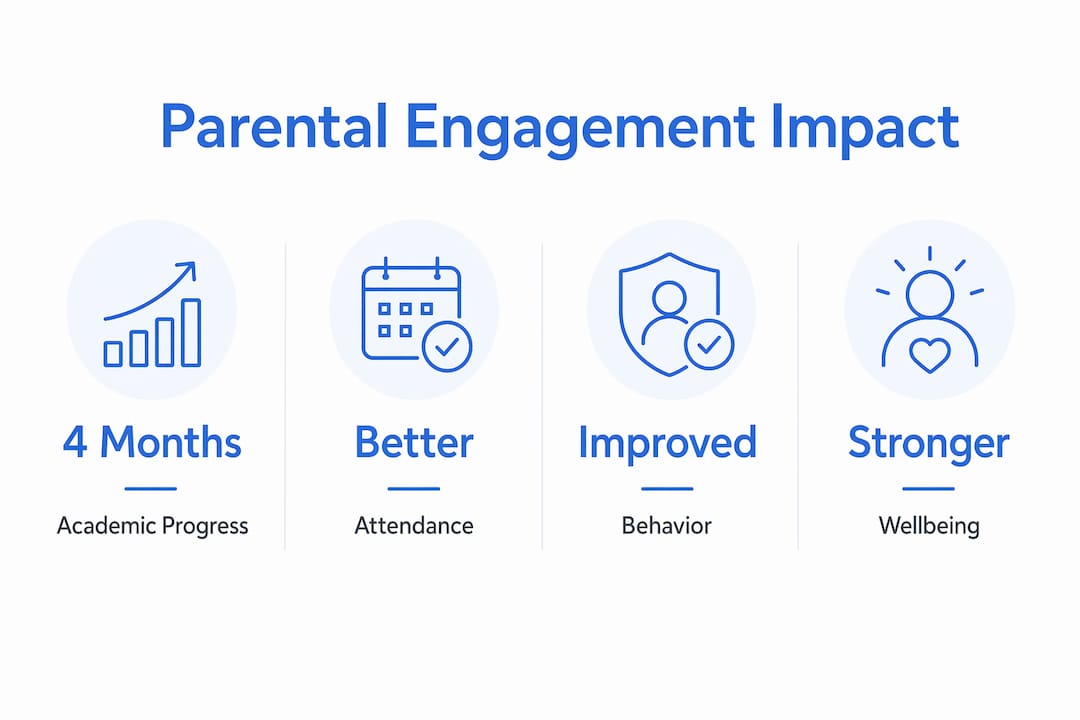
The table below summarises the key impact areas identified across the research.
| Impact area | Outcome |
|---|---|
| Academic progress | Average of four months’ additional progress per year in literacy and maths |
| Attendance | Improved punctuality and reduced unauthorised absences |
| Behaviour | More positive classroom conduct and reduced exclusions |
| Social development | Stronger peer relationships and communication skills |
| Emotional wellbeing | Greater resilience and self-regulation in learning contexts |
Wellbeing outcomes are often underweighted in school improvement planning. Schools that treat parental engagement purely as an academic lever miss the broader picture. When parents feel genuinely connected to a school, children feel more secure. That security translates into confidence in the classroom.
What activities and practices make parental engagement effective?
Effective parental engagement is built from consistent, purposeful actions rather than one-off events. Research confirms that multi-faceted engagement behaviours at home and school are what drive outcomes, not attendance at a single open evening. The following activities represent the strongest evidence-based practices.
- Supporting schoolwork at home: Reading with children, discussing what they are learning, and creating a quiet space for homework all reinforce classroom learning without requiring specialist knowledge.
- Regular communication with educators: Proactive contact with teachers, not just at parents’ evenings, builds the relational trust that makes difficult conversations easier when they arise.
- Participating in school events: Attending curriculum workshops, information evenings, and school productions signals to children that their parents value education.
- Shaping educational values: Conversations at home about the importance of effort, curiosity, and perseverance have a lasting effect on a child’s attitude to learning.
- Contributing to school governance: Parents who sit on governing bodies or join parent forums bring a family perspective that improves school decision-making.
Sustained effort is the factor most schools underestimate. The Education Endowment Foundation notes that effective engagement programmes typically last 18 weeks or longer to build the trust and collaborative habits that produce lasting change. A single workshop or a termly newsletter will not move the dial.
Pro Tip: Send home a brief, structured learning prompt each week, not just homework instructions. A question like “Ask your child to explain what they learned about fractions today” gives parents a concrete way to engage without needing subject expertise.
How is digital technology transforming parental engagement?
Digital tools have fundamentally changed what is possible in parent-school communication. What is digital parent engagement? It is the use of online platforms, mobile apps, parent portals, and virtual meetings to create consistent, accessible channels between families and schools. A study of 388 participants found that strategic digital engagement using portals and educational apps correlates with higher grades, better attendance, and improved assignment completion rates. The key word is strategic. The technology is only as effective as the communication culture it supports.
The most effective digital engagement practices follow a clear structure.
- Use a parent portal for real-time updates. Portals that show attendance records, assessment results, and homework assignments give parents accurate information without requiring staff to field individual queries. Eschools’ parent portal solutions are built specifically for this purpose.
- Send targeted, two-way messages. Broadcast messages have their place, but the most engaged parents are those who receive personalised communication and have a clear channel to respond.
- Offer virtual meeting options. Video appointments for parents’ evenings and pastoral reviews remove the barrier of travel and work schedules, increasing attendance from families who would otherwise disengage.
- Use mobile apps for instant communication. Push notifications reach parents faster than email and are more likely to prompt a response. Eschools’ mobile app is designed to make this kind of contact straightforward for both staff and families.
- Track engagement data. Knowing which parents are not opening messages or logging into portals allows schools to identify families who need a different approach.
The risks of digital engagement deserve equal attention. Research shows that excessive digital monitoring can generate parental stress, increase student anxiety, and reduce a child’s sense of autonomy. A parent who checks a portal ten times a day and messages teachers after every assessment is not engaged in a healthy way. Schools need to set clear expectations about communication frequency and response times.
Pro Tip: Establish a published communication charter that sets out when parents can expect responses and what channels are appropriate for different types of contact. This protects staff time and models healthy boundaries for families.
What challenges and barriers affect parental engagement?
Barriers to parental engagement are real, varied, and often invisible to school leaders. Research using the Tripartite Model of Engaging Parents in Online Learning categorises these barriers into three types: internal, external, and transactional. Understanding which type of barrier a family faces determines which response will actually help.
- Internal barriers include low parental confidence, negative memories of school, and uncertainty about how to support learning at home.
- External barriers include work schedules, caring responsibilities, transport, digital access, and language differences.
- Transactional barriers arise from the relationship between the school and the family, including inadequate communication, lack of training for staff, and systems that make it difficult for parents to participate.
Equity is central to this conversation. Culturally responsive partnerships treat diverse family experiences as assets rather than deficits. A school that only communicates in formal written English, only holds events in the evening, and only values involvement that looks like volunteering will systematically exclude large portions of its parent community.
“Family engagement is most effective when families are partners in decision-making and everyday learning, not just event participants.” — Brookings Institution
Practical strategies for addressing these barriers include offering translated communications, running daytime as well as evening events, providing digital devices or data support for families without reliable internet access, and training staff to approach parent contact with curiosity rather than assumption. The goal is to remove the friction that prevents willing parents from participating, while also building the confidence of parents who do not yet see themselves as partners in their child’s education. Schools that invest in effective school communication consistently report stronger family relationships and better outcomes for pupils.
Key takeaways
Parental engagement is the most cost-effective school improvement lever available, delivering four months’ additional academic progress when schools commit to genuine two-way partnership with families.
| Point | Details |
|---|---|
| Engagement differs from involvement | True engagement requires two-way communication and active family participation in educational decisions. |
| Academic impact is significant | The Education Endowment Foundation links effective engagement to four months’ additional progress per year. |
| Sustained effort is required | Effective programmes last 18 weeks or longer; one-off events do not build lasting partnerships. |
| Digital tools must be used carefully | Portals and apps improve outcomes when used strategically, but excessive monitoring harms student autonomy. |
| Barriers require targeted responses | Internal, external, and transactional barriers each need different solutions to achieve equitable engagement. |
The difference between notifying and genuinely engaging parents
The most common mistake I see schools make is confusing communication volume with engagement quality. A school can send three messages a week, maintain a busy social media presence, and still have parents who feel entirely disconnected from their child’s education. The problem is not the frequency. The problem is the direction.
Real engagement happens when a parent feels that their perspective changes something. That might be a teacher who adjusts their approach after a conversation with a family. It might be a school that redesigns its homework policy after consulting parents. It might simply be a member of staff who listens without immediately defending the school’s position. These moments build trust in a way that no newsletter ever will.
Digital tools have made it easier to communicate at scale, and that is genuinely valuable. But the schools I have seen achieve the strongest family partnerships are the ones that use technology to create more space for human conversation, not to replace it. A parent portal that shows attendance data is useful. A phone call from a form tutor who noticed that attendance has dropped and wanted to understand why is transformative.
The other thing I would say is this: patience matters more than most schools acknowledge. The Education Endowment Foundation’s finding that effective programmes last 18 weeks or longer is not a bureaucratic detail. It reflects the reality that trust between families and schools is built slowly, through repeated positive interactions, and can be damaged quickly by a single dismissive exchange. Schools that treat engagement as a long-term relational investment, rather than a termly initiative, are the ones that see it become part of their culture.
— Ed
How Eschools helps schools build stronger family partnerships
Eschools has supported UK schools and multi-academy trusts for over 14 years, building digital tools that make genuine parent-school communication practical rather than aspirational. The platform brings together parent portals, mobile apps, and parents’ evening booking into a single, accessible system that reduces administrative burden while increasing the quality of family contact.
Every tool Eschools builds is designed around the principle that good communication should be easy for staff to send and easy for parents to receive and respond to. That two-way design is what separates a notification system from an engagement platform. If you want to see how schools are using Eschools to improve family partnerships in practice, the Our Work page shows real examples from schools across the UK. The results speak for themselves.
FAQ
What is parental engagement in education?
Parental engagement is the active, two-way collaboration between parents and schools that supports a child’s learning and development. It goes beyond attendance at events to include home learning support, regular communication with educators, and participation in school decision-making.
How does parental engagement improve academic outcomes?
The Education Endowment Foundation links effective parental engagement to an average of four months’ additional academic progress per year, with the strongest gains in literacy and maths.
What is digital parent engagement?
Digital parent engagement uses online platforms, mobile apps, parent portals, and virtual meetings to create consistent communication channels between families and schools. Research shows that strategic use of these tools correlates with higher grades and better attendance.
What are the main barriers to parental engagement?
Barriers fall into three categories: internal (low confidence or negative school memories), external (work schedules, digital access, language), and transactional (poor school communication or lack of staff training). Addressing all three is necessary for equitable engagement.
How long does it take to build effective parental engagement?
Effective engagement programmes typically last 18 weeks or longer, according to the Education Endowment Foundation. Building genuine trust between families and schools is a long-term process that requires sustained, consistent effort rather than one-off initiatives.