TL;DR:
- Investing in school IT reduces staff workload and enhances operational efficiency through automation and online services.
School IT investment is defined as the planned allocation of budget and resources to digital tools, infrastructure, and systems that improve educational outcomes and operational efficiency. For school leaders and governors, the question is not whether to invest, but how to justify it clearly and spend it well. The UK government’s Digital and Data Benefits framework, UNESCO’s GEM Report 2023, and the OECD Digital Education Outlook 2026 all confirm that technology delivers measurable returns when deployed with the right governance and teacher preparation. This guide explains why invest in school IT is a question with a clear, evidence-based answer.
Why invest in school IT: the operational case
The most direct argument for investing in educational IT is the reduction of administrative burden on staff. The UK government’s Digital and Data Benefits framework identifies three core benefit streams: productivity gains, channel shift, and effectiveness improvements. Each stream has a direct equivalent in school operations.

Productivity gains come from automating routine tasks. Attendance recording, report generation, and parent communications all consume significant staff time when handled manually. Shifting these processes to school management software frees teachers and administrators to focus on higher-value work.
Channel shift means moving services online rather than handling them through paper, phone, or in-person processes. Automating paper processing and reducing contractor dependency lowers operational costs and improves service resilience. A school that replaces paper consent forms with a digital system, for example, removes a failure point and cuts processing time considerably.
| Process | Traditional approach | IT-enabled approach |
|---|---|---|
| Attendance recording | Manual registers, paper-based | Automated digital registers, real-time alerts |
| Parent communication | Letters, phone calls | App notifications, email, online portals |
| SEND record-keeping | Paper files, manual updates | Centralised digital records, instant access |
| Parents’ evening booking | Phone or paper slips | Online booking systems, automated reminders |
| Report generation | Manual data entry | Automated from management information systems |
Pro Tip: When building your operational efficiency case, map every paper-based process your school runs and assign a staff-hour cost. The total figure almost always surprises governors and makes the investment case write itself.
How does school IT improve learning outcomes?
Educational technology improves learning outcomes when it is aligned with clear teaching strategies, not when it is simply purchased and deployed. The OECD Digital Education Outlook 2026 reports that generative AI improves student task performance in the short term, but real learning gains require pedagogical alignment and sustained evaluation. That distinction matters enormously for school leaders approving budgets.
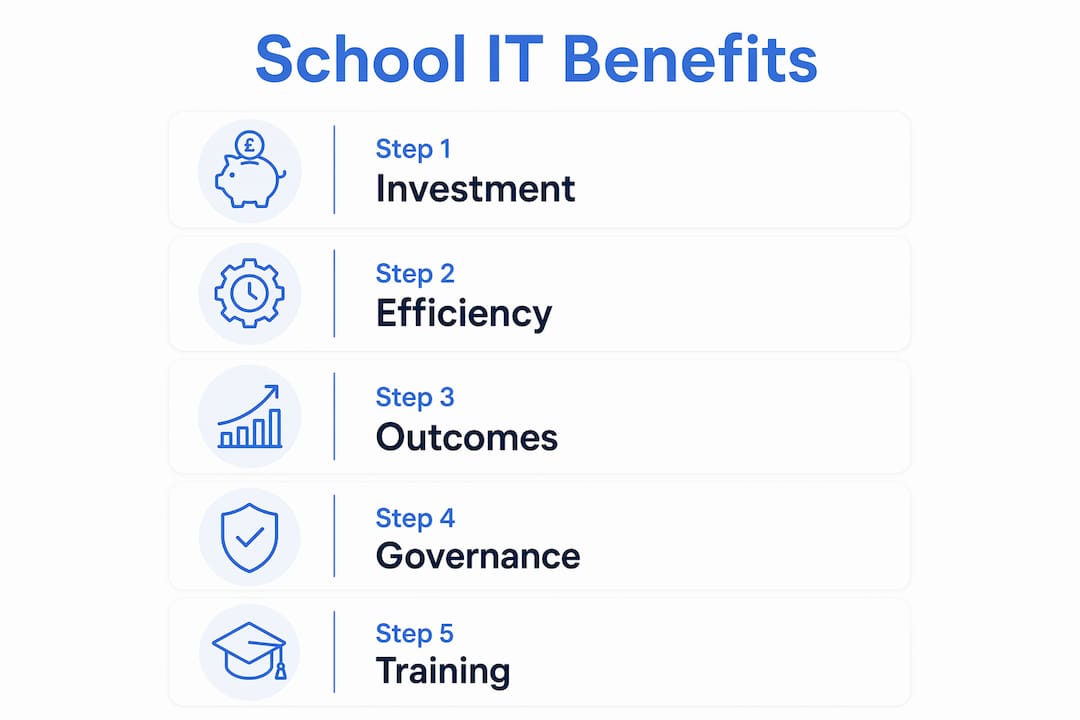
The OECD also finds that edtech co-designed with teachers amplifies teaching capacity beyond what either AI or teachers can achieve alone. This means the value of IT in education is not about replacing professional judgement. It is about extending what skilled teachers can do within the time they have.
Effective digital classroom tools for UK schools include:
- Learning management systems (LMS): Centralise lesson resources, assignments, and feedback in one place, reducing the time teachers spend distributing materials.
- Formative assessment tools: Allow teachers to check understanding in real time, adjusting lessons without waiting for end-of-unit tests.
- Generative AI writing assistants: Support drafting and editing tasks, freeing lesson time for discussion and deeper analysis when used with clear pedagogical intent.
- Video and multimedia platforms: Enable flipped learning models where pupils review content at home and use class time for application.
- Online collaboration tools: Support group work and peer feedback, skills that Ofsted increasingly expects schools to evidence.
Pro Tip: Before purchasing any edtech tool, ask the supplier for evidence of learning impact from schools with a similar demographic profile to yours. Generic case studies rarely predict outcomes accurately.
Why governance and teacher preparation determine IT investment success
Technology alone does not improve schools. UNESCO’s GEM Report 2023 is unambiguous: technology impacts education through multiple channels, but only delivers its potential when system-wide conditions including teacher preparation and governance are in place. This is the finding that most school leaders underestimate when planning IT budgets.
Teacher preparation is the hidden variable in almost every failed edtech rollout. Ongoing training and workflow redesign must be budgeted explicitly alongside any technology purchase. A school that spends £50,000 on devices but allocates nothing for staff development will see minimal impact. A school that spends £35,000 on devices and £15,000 on structured training and support will see measurable change.
Governance structures matter equally. Your school’s digital strategy should link every IT investment to a defined outcome, with a monitoring plan attached. The UK government’s guidance on structuring digital programmes recommends tracking benefits over the full project lifecycle, not just at the point of purchase.
| Readiness factor | What it requires | Impact if absent |
|---|---|---|
| Teacher preparation | Structured CPD, workflow redesign, ongoing support | Tools unused or misused; no learning gain |
| Governance framework | Digital strategy, outcome targets, monitoring plan | No accountability; budget wasted |
| Infrastructure | Reliable connectivity, device access, technical support | Lessons disrupted; staff frustration |
| Leadership buy-in | Senior champion, clear communication to staff | Resistance to adoption; patchy implementation |
The practical steps for school leaders are straightforward. Appoint a digital lead with time allocated to the role. Write a digital strategy that names specific outcomes. Build CPD into every technology procurement. Review impact termly, not annually. These steps cost relatively little but determine whether your investment delivers.
How does school IT investment support SEND learners?
Technology investment has a specific and well-evidenced role in supporting pupils with special educational needs and disabilities (SEND). UK government policy links digital tools to SEND support by enabling faster access to specialised help and better recording of additional needs. For school leaders, this is both an equity argument and a compliance argument.
The impact of school technology on inclusion is most visible in the following areas:
- Digital record-keeping for SEND: Centralised systems allow SENCOs, class teachers, and external specialists to access and update pupil records without delay, reducing the risk of support gaps.
- Speech and language technology: Digital platforms enable speech therapy exercises to be completed in school or at home, extending the reach of specialist services beyond scheduled appointments.
- Assistive technology: Text-to-speech, screen readers, and adaptive input devices give pupils with physical or cognitive barriers independent access to the curriculum.
- Communication tools for parents: Families of SEND pupils often need more frequent contact with school. Digital communication platforms reduce the friction of that contact and improve parental confidence.
- Data-driven early identification: Management information systems that flag attendance patterns, attainment dips, or behavioural changes help staff identify pupils who may need additional support before a crisis develops.
Equity is the underlying principle here. A school that invests in technology for its highest-attaining pupils but not for its most vulnerable ones is not making a sound investment. The strongest cases for school IT funding address the full range of learner needs.
What frameworks help justify and measure school IT investment?
School leaders need a structured approach to building the investment case, particularly when presenting to governors or a multi-academy trust (MAT) board. CoSN’s Value of Investment framework provides the clearest model available. It distinguishes between financial ROI (return on investment) and what CoSN calls ROI², or Return on Instruction. Both must be measured to build a compelling case.
Financial ROI covers cost savings from automation, reduced printing, lower contractor costs, and improved staff retention through reduced workload. Return on Instruction covers learning gains, pupil progress, and teaching quality improvements. Presenting both to governors demonstrates that the investment serves the school’s educational mission, not just its budget.
A practical investment case follows these steps:
- Define the problem. Identify the specific inefficiency or learning gap the investment addresses. Vague justifications fail at board level.
- Quantify current costs. Calculate staff hours, paper costs, and contractor fees associated with the current process.
- Model the benefit. Use the UK government’s benefit categories (productivity, channel shift, effectiveness) to frame expected returns.
- Include risk reduction. Cybersecurity investment, for example, protects against data breaches that carry both financial and reputational costs.
- Set monitoring milestones. Define what success looks like at three months, six months, and one year after implementation.
- Budget for training. Include CPD costs in the total investment figure, not as an afterthought.
Pro Tip: Use CoSN’s VOI workbooks to structure your board presentation. Governors respond to frameworks they recognise. Presenting financial and instructional returns side by side removes the perception that IT spending is discretionary.
Key takeaways
School IT investment delivers measurable returns only when technology is matched with governance structures, teacher preparation, and a clear monitoring plan aligned to both operational and instructional outcomes.
| Point | Details |
|---|---|
| Operational efficiency | Automating attendance, communications, and records reduces staff workload and cuts costs. |
| Learning outcomes | Edtech aligned with pedagogy improves results; tools without teaching strategy do not. |
| Teacher preparation | Budget explicitly for CPD alongside every technology purchase or impact will be minimal. |
| SEND and inclusion | Digital tools improve record-keeping, assistive access, and specialist service reach for SEND pupils. |
| Investment case | Use CoSN’s VOI framework to present both financial ROI and instructional returns to governors. |
The uncomfortable truth about school IT spending
Having worked with school leaders across the UK for over a decade, I have seen the same pattern repeat itself. A school purchases a well-reviewed platform, rolls it out with a brief staff briefing, and then wonders why nothing changes six months later. The technology was fine. The investment case was weak because it stopped at the purchase.
The research is consistent on this point. UNESCO, the OECD, and the UK government all say the same thing in different ways: the tool is not the intervention. The intervention is the combination of the tool, the training, the governance, and the monitoring. Schools that understand this spend their IT budgets very differently from those that do not.
I am also cautious about the current enthusiasm for generative AI in classrooms. The OECD’s finding that AI improves short-term task performance but not necessarily long-term learning is a warning, not a reason to avoid AI entirely. It is a reason to be precise about what you are trying to achieve before you sign a contract. Ask whether the tool is designed to replace thinking or to extend it. The answer tells you almost everything you need to know about its long-term value.
The schools I see making the strongest IT investments are not necessarily the ones with the largest budgets. They are the ones where the headteacher treats technology as a professional development question first and a procurement question second. That shift in framing changes everything.
— Ed
How Eschools supports UK schools with practical digital solutions
Eschools has supported UK schools and multi-academy trusts for over 14 years, providing digital tools that address the exact challenges this article covers.

From bespoke school websites that improve parental engagement and statutory compliance, to online learning platforms and parent evening booking systems, Eschools builds solutions around how schools actually work. MAT leaders can explore centralised trust solutions that give consistent governance and communication across multiple sites. If you want to see what these solutions look like in practice, the Eschools Our Work page shows real examples from schools across the UK.
FAQ
Why invest in school IT rather than other budget areas?
School IT investment delivers returns across multiple areas simultaneously, including reduced staff workload, improved learning outcomes, and better SEND support. The UK government’s Digital and Data Benefits framework confirms that digital programmes improve efficiency while also improving outcomes, making IT one of the few budget areas with both operational and educational returns.
How does school IT investment benefit SEND pupils specifically?
Digital tools enable faster access to specialist support, better record-keeping for SENCOs, and assistive technology that gives SEND pupils independent curriculum access. UK government guidance links digital inclusion funding directly to improved outcomes for learners with additional needs.
What is CoSN’s VOI framework and why does it matter?
CoSN’s Value of Investment framework separates financial ROI from instructional ROI, helping school leaders present a complete picture of technology benefits to governors. It matters because boards that only see cost savings often undervalue the learning impact of well-deployed edtech.
Does buying educational AI tools guarantee better results?
No. The OECD finds that generative AI improves short-term performance but sustained learning gains only follow when AI is integrated with clear pedagogical strategies and ongoing evaluation.
How much should schools budget for teacher training alongside IT?
No universal figure is publicly set, but UNESCO’s GEM Report 2023 states that teacher preparation determines measurable improvement from IT investments. Training, workflow redesign, and instructional support must be costed explicitly in every technology procurement, not treated as optional extras.