
Effective communication sits at the heart of every successful multi-academy trust. When processes break down, the consequences are real: parents disengage, staff feel uninformed, and complaints escalate. Confusion spreads quickly across multiple schools when messaging lacks structure or consistency. The good news is that effective communication strategies involving audience audits, clear structure, and feedback loops can prevent these problems and build genuine trust. This guide walks you through a practical, evidence-driven approach to transforming how your MAT communicates, from assessing your current needs to selecting the right digital tools and measuring real impact.
Table of Contents
- Assessing communication needs in multi-academy trusts
- Structuring effective communication processes
- Digital tools for communication and collaboration
- Monitoring results and refining your approach
- Why nuanced communication trumps one-size-fits-all
- How eSchools helps multi-academy trusts transform communication
- Frequently asked questions
Key Takeaways
| Point | Details |
|---|---|
| Audit your audience | Regularly survey stakeholders to tailor content and channels for better engagement. |
| Structure for clarity | Organise communication with clear purpose and feedback loops to build trust. |
| Leverage digital tools | Digital platforms and apps centralise processes and improve collaboration across MATs. |
| Monitor results | Track outcomes like Progress 8 scores and Ofsted ratings to refine communication strategy. |
| Balance centralisation | Effective MATs combine central oversight with responsive, localised approaches. |
Assessing communication needs in multi-academy trusts
Before you change anything, you need to understand what is actually happening. Too many MATs invest in new tools without first mapping who they are communicating with, how often, and through which channels. The result is duplication, overload, and disengagement.
An audience audit is your starting point. Audit audiences regularly via surveys and focus groups to tailor channels and content, preventing overload and enhancing engagement. This means speaking directly to parents, staff, governors, and pupils to understand what information they need, when they need it, and how they prefer to receive it.
Here is what a thorough audit should cover:
- Who your key audiences are across each school in the trust
- What information each group needs and how frequently
- Which channels they currently use and trust (email, app notifications, newsletters, social media)
- Where communication is falling short or creating confusion
- How different schools within the trust differ in their communication culture
Once you have this data, you can map your channels against your audiences and identify gaps. A simple comparison table helps visualise this clearly:
| Audience | Preferred channel | Current gap |
|---|---|---|
| Parents | Mobile app, email | Inconsistent updates |
| Teaching staff | Email, intranet | Too many platforms |
| Governors | Formal reports, email | Lack of transparency |
| Pupils | Classroom tools, app | Limited two-way dialogue |
Pro Tip: Run a short pulse survey at the start of each academic year. Five questions are enough to reveal whether your communication approach still matches your audience’s expectations.
For MATs managing multiple schools, MAT websites and compliance considerations should be factored into your audit from the outset. Statutory requirements shape what you must publish, and your audit should confirm whether current channels meet those obligations.
Structuring effective communication processes
Once needs are mapped, the next step is to design structured, transparent processes. Knowing your audience is only useful if your messaging is built to serve them clearly.

Effective communication strategies involve structured content, transparent tone, and feedback loops to build trust. In practice, this means every piece of communication your MAT sends should follow a consistent format that makes it easy to act on.
Here is a reliable structure for MAT messaging:
- Purpose: State clearly why you are communicating and what has prompted the message
- Key information: Deliver the essential facts without unnecessary padding
- Next steps: Tell the reader exactly what action, if any, is required
- Feedback route: Provide a clear way for the reader to respond or ask questions
- Timeline: Indicate any relevant deadlines or dates
Transparency is not just a tone choice. It is a cultural commitment. When your trust communicates openly about decisions, including difficult ones, stakeholders feel respected rather than managed. This builds long-term confidence in your leadership.
“Transparency in communication is not about sharing everything. It is about sharing the right things, clearly and consistently, so that people feel informed and valued.”
Feedback loops are often the weakest link in MAT communication. Many trusts send information outward but have no reliable mechanism for capturing responses. Consider digital suggestion tools, regular staff briefings with open Q&A, and termly parent surveys as standard practice.
Pro Tip: Assign a named communication lead at each school within the trust. This person becomes the local point of contact and ensures messages are received, understood, and acted upon consistently.
For practical support on building these processes, edtech solutions for MATs can automate routine communications and reduce the administrative burden on school leaders. You should also review DfE governance guidance to ensure your processes align with statutory expectations.
Digital tools for communication and collaboration
With structure in place, it is time to select and leverage the right digital tools. The market is crowded, and not every platform suits every MAT. The key is matching tools to your communication goals rather than adopting technology for its own sake.
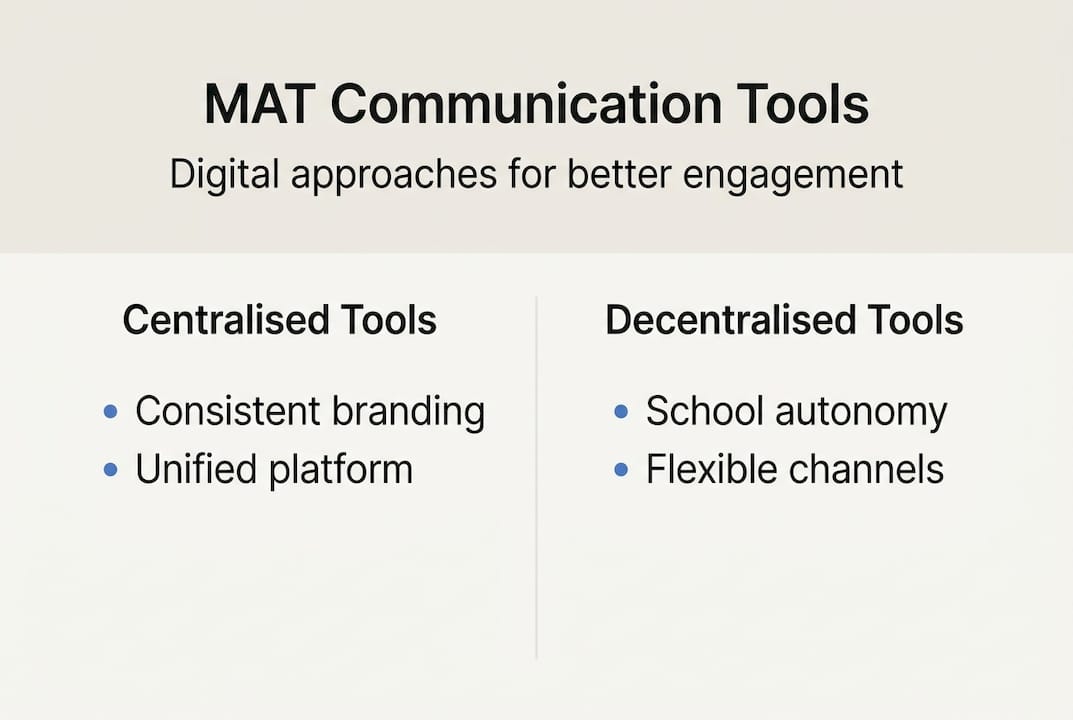
Centralised control ensures consistency but risks eroding school autonomy. This tension is real. A trust-wide platform that standardises everything may feel alien to individual schools with distinct identities. The best approach balances central oversight with local flexibility.
Here is a comparison of centralised versus decentralised digital communication models:
| Feature | Centralised model | Decentralised model |
|---|---|---|
| Brand consistency | High | Variable |
| School autonomy | Low | High |
| Data oversight | Easier | More complex |
| Staff adoption | Can face resistance | Generally smoother |
| Compliance monitoring | Straightforward | Requires coordination |
The most effective MATs tend to adopt a hybrid approach: a shared platform for trust-level communications and compliance, with flexibility for individual schools to manage local content.
Key digital tools worth considering include:
- School websites with centralised content management for compliance pages
- Mobile apps for real-time parent and staff notifications
- Online learning platforms that support both teaching and communication
- Collaborative tools such as shared document platforms for staff across schools
Exploring digital classroom tools designed for UK schools can help you identify what fits your trust’s specific context. For parent and staff engagement on the move, MAT mobile apps offer a streamlined way to push notifications and updates without relying on email.
Pro Tip: Before rolling out any new platform, pilot it with one school in your trust. Gather honest feedback from staff and parents before committing to a full deployment.
Monitoring results and refining your approach
Now, let us turn to verifying the impact and iterating for long-term success. Implementing a communication strategy without measuring its effect is like teaching without assessing. You simply do not know what is working.
The evidence for getting this right is compelling. Top 10% MATs outperform local authorities by 0.2 Progress 8 score overall, with even greater gains for disadvantaged pupils. Sponsored academies improve faster when governance and communication structures are strong. These are not abstract figures. They represent real outcomes for real pupils.
To monitor communication impact effectively, track the following:
- Engagement rates on digital platforms (email open rates, app notification responses)
- Parent survey results collected termly or annually
- Staff feedback from focus groups or pulse surveys
- Complaint volumes and the nature of recurring issues
- Ofsted inspection feedback relating to communication and governance
- Progress 8 trends across schools in the trust over time
When you spot a drop in engagement or a spike in complaints, treat it as a signal rather than a failure. Common process failures include: messages sent too frequently, unclear calls to action, inconsistent tone across schools, and feedback channels that are never monitored.
Refinement should be built into your annual planning cycle. Set a communication review date each year, bring together data from all schools, and adjust your strategy accordingly. For ideas on strengthening the learning environment alongside communication, improving online learning in UK schools offers practical guidance.
Why nuanced communication trumps one-size-fits-all
Monitoring results often reveals a deeper truth that many MAT leaders are reluctant to acknowledge: the drive for consistency can quietly undermine the very engagement you are trying to build.
We see this pattern regularly. A trust invests in a single communication platform, rolls it out across all schools, and then wonders why uptake is patchy and parents remain disengaged. The problem is not the platform. It is the assumption that every school in the trust has the same communication culture, the same audience expectations, and the same relationship with digital tools.
Centralised control ensures consistency but risks eroding school autonomy, and that erosion has real consequences for community trust. A school with a strong local identity may find that trust-wide messaging feels impersonal or irrelevant to its families.
The most successful MATs we observe are those that treat communication as a living, audience-specific practice rather than a broadcast operation. They use formal networks for compliance and governance, but they also invest in informal collaboration between school leaders, allowing local knowledge to shape how messages are framed and delivered.
The practical wisdom here is straightforward: give your schools a shared framework, but give them room to speak in their own voice within it. That balance, between trust-wide coherence and school-level authenticity, is where genuine engagement lives.
How eSchools helps multi-academy trusts transform communication
For MATs keen to implement these improvements, dedicated platforms make the process considerably easier.

eSchools has supported schools and multi-academy trusts for over 14 years, providing MAT websites and centralised platforms that balance trust-wide consistency with the flexibility individual schools need. From compliance-ready website solutions to mobile apps that keep parents and staff informed in real time, our tools are built around the realities of MAT leadership. You can explore our work with MATs to see how other trusts have used our solutions to strengthen communication and engagement. For schools focused on parent relationships, our school websites for parent engagement offer a straightforward, effective starting point.
Frequently asked questions
What are the most effective communication channels for MATs?
Audited channels tailored to audience needs are most effective. Tailoring channels and content via regular surveys and focus groups ensures the right information reaches the right people through email, digital platforms, and mobile apps.
How can communication improve MAT performance?
Clear communication processes are linked to stronger pupil outcomes. Top 10% MATs outperform local authorities by 0.2 Progress 8 score, with sponsored academies showing faster improvement when governance and communication are strong.
What feedback mechanisms should MATs use?
Effective feedback in MATs includes termly surveys, digital suggestion tools, and staff focus groups. Structured feedback loops build trust and ensure communication remains responsive to stakeholder needs.
How often should MATs communicate with stakeholders?
Frequency should be guided by stakeholder feedback and engagement data rather than a fixed schedule. Balanced frequency prevents overload, and audience audits help you calibrate timing for each group.
Are digital platforms essential for modern MAT communication?
Yes. Digital platforms enable consistent, transparent engagement across multiple schools. AI and digital adoption drive improved engagement and outcomes in MATs, particularly when tools are chosen to match the trust’s specific communication needs.