
TL;DR:
- Improving a school’s online presence requires a technically sound website, active Google Business Profile, and consistent social media engagement to build trust and attract students. Regularly updating profiles, responding to reviews, and sharing relevant content greatly enhance local visibility and community connection. Most schools underestimate the power of consistency and proper technical foundations in long-term digital success.
Improving a school’s online presence is the process of strategically enhancing its visibility, engagement, and reputation across digital platforms to attract and retain students and parents. In 2026, this discipline sits at the intersection of local SEO, website performance, and community engagement. 89% of parents start researching schools online, and Google’s local Map Pack captures up to 44% of clicks for education queries. That means your school’s digital footprint is not a marketing nicety. It is a direct driver of enrolment and community trust. The tools that matter most are Google Business Profile, a technically sound website, and consistent social media activity across platforms such as Facebook and Instagram.
How to improve online presence for schools: the website foundation
Your school website is the single most consequential digital asset you control. It is the first place prospective parents land after a Google search, and parents decide within 3 seconds whether to explore further or leave. That is an extraordinarily short window, and it is determined almost entirely by design, speed, and clarity.
The best practices for school websites in 2026 centre on a small number of non-negotiable technical and structural requirements:
- Mobile responsiveness and loading speed. 60% of school website traffic arrives via mobile devices, and any page that loads in more than three seconds will lose a significant proportion of those visitors. This is not a design preference. It is a performance threshold.
- Clear navigation aligned to parent behaviour. Parents searching for admissions information, term dates, or safeguarding policies should find them within two clicks. Burying key pages under multiple menu layers creates friction and erodes trust.
- Technical SEO foundations. Logical site architecture, XML sitemaps, and schema markup directly influence how search engines and AI platforms interpret your content. Meta titles and descriptions should include your school name, location, and key phrases such as “primary school in [town].”
- Enquiry forms and enrolment calls to action. Every key page should offer a clear next step. A prospective parent reading your curriculum page should be one click away from booking a tour or submitting an enquiry.
- Trust signals. Testimonials from current parents, Ofsted ratings, award badges, and professional photography all contribute to the credibility a visitor needs before making contact.
Pro Tip: Schools publishing monthly blog posts that answer common parent questions see substantial increases in organic search discovery. A post titled “What to expect at your Year 7 induction” costs very little to produce and can drive consistent traffic for years.
Accessibility is equally non-negotiable. Ensuring inclusivity and legal compliance through accessible design broadens your audience and protects your school from reputational and legal risk. The Eschools guide on school website accessibility sets out the specific requirements UK school leaders must meet.
How to optimise your Google Business Profile for local search
Google Business Profile (GBP) is the most underused tool in most schools’ digital strategy. When a parent types “primary school near me” into Google, the three results that appear in the Map Pack are determined almost entirely by GBP completeness, activity, and review signals. A static, unclaimed, or neglected profile is a direct competitive disadvantage.
Follow these steps to get your profile working properly:
- Claim and verify your profile. Go to Google Business Profile and search for your school. If it exists but is unclaimed, request ownership. Verification typically takes a few days via postcard or phone.
- Set accurate NAP and categories. NAP stands for Name, Address, and Phone number. These must match exactly what appears on your website and any directory listings. Select “School” as your primary category and add relevant secondary categories such as “Primary School” or “Secondary School.”
- Upload 20 or more professional photos. Profiles with over 20 photos see 35% higher clicks. Include images of classrooms, outdoor spaces, events, and staff. Refresh these regularly rather than uploading once and forgetting.
- Post weekly updates. Weekly profile updates generate 70% higher views. Use posts to share term dates, open days, achievements, and news. This signals to Google that your profile is active and authoritative.
- Respond to every review. Sending review requests within 48 hours of a positive interaction improves review volume and local ranking signals. Respond professionally to all feedback, including critical reviews, to demonstrate transparency.
- Enable messaging. GBP messaging enabled with a quick response time improves direct parent enquiries. Link your profile directly to your enrolment or contact page to reduce friction.
Pro Tip: Treat your GBP as a dynamic local entity profile rather than a static directory listing. Schools that post weekly and refresh photos monthly consistently outperform those that set up the profile once and leave it.
Which social media strategies best enhance school brand and community interaction?
Social media is where your school’s personality becomes visible. A well-managed presence on Facebook and Instagram builds the kind of authentic community connection that no website copy can replicate. The key is selecting the right platforms and maintaining a consistent brand identity across all of them.

Consistent branding across your website, social profiles, and Google listings increases enrolment enquiries by over 25%. That figure reflects something school leaders often underestimate: parents are cross-referencing your digital presence before they ever make contact. Inconsistency in logos, tone, or messaging creates doubt.
Practical social media guidance for school leaders:
- Choose platforms strategically. Facebook remains the primary platform for parents of school-age children in the UK. Instagram is effective for visual storytelling and reaching a younger demographic. LinkedIn is worth maintaining for staff recruitment and professional reputation.
- Maintain visual consistency. Use the same colour palette, logo placement, and tone of voice across every channel. This is not about rigid uniformity. It is about being immediately recognisable.
- Prioritise content that celebrates the community. Student achievements, sports days, arts performances, and staff spotlights generate far higher engagement than administrative announcements. Parents share content that reflects well on their child’s school.
- Post with discipline. Posting 3 to 5 times per week on Facebook and using daily Instagram stories with engaging visuals generates measurable community engagement. High-quality content always outperforms high-frequency, low-value posting.
- Use local hashtags. Tags such as #[TownName]Schools or #[LocalArea]Education extend your reach to prospective families who are not yet following your account.
For a deeper look at engaging parents online, the Eschools guide covers platform-specific tactics in detail.
How can schools manage and improve their online reputation consistently?
Online reputation management for schools is the practice of systematically monitoring, responding to, and shaping how your school is perceived across digital platforms. It is not crisis management. It is an ongoing operational discipline.
Here is a practical process for building and maintaining a strong reputation:
- Build a review request process. After open days, parents’ evenings, or positive milestones, send a brief, friendly message asking parents to share their experience on Google. Timing matters. Review requests sent within 48 hours of a positive interaction produce significantly higher response rates.
- Respond to all feedback professionally. A thoughtful response to a critical review demonstrates maturity and transparency. It also signals to prospective parents reading those reviews that your school takes concerns seriously.
- Monitor your mentions. Set up Google Alerts for your school name and any common variations. This surfaces mentions across news sites, forums, and social media that you might otherwise miss.
- Showcase positive stories strategically. Do not wait for parents to find good news. Share Ofsted praise, community awards, and student success stories prominently on your website and social channels.
- Prepare a crisis response framework. If a negative story gains traction, a pre-agreed response protocol prevents inconsistent or reactive messaging. Designate a spokesperson and agree on the communication channels you will use.
“Transparency is the most powerful reputation tool a school has. Parents who see a school respond honestly to criticism are more likely to trust it than one that appears to have only five-star reviews.”
Successful school SEO requires moving beyond promotional language to credible, comprehensive information that answers complex questions. Reputation management and content strategy are two sides of the same coin.
Key takeaways
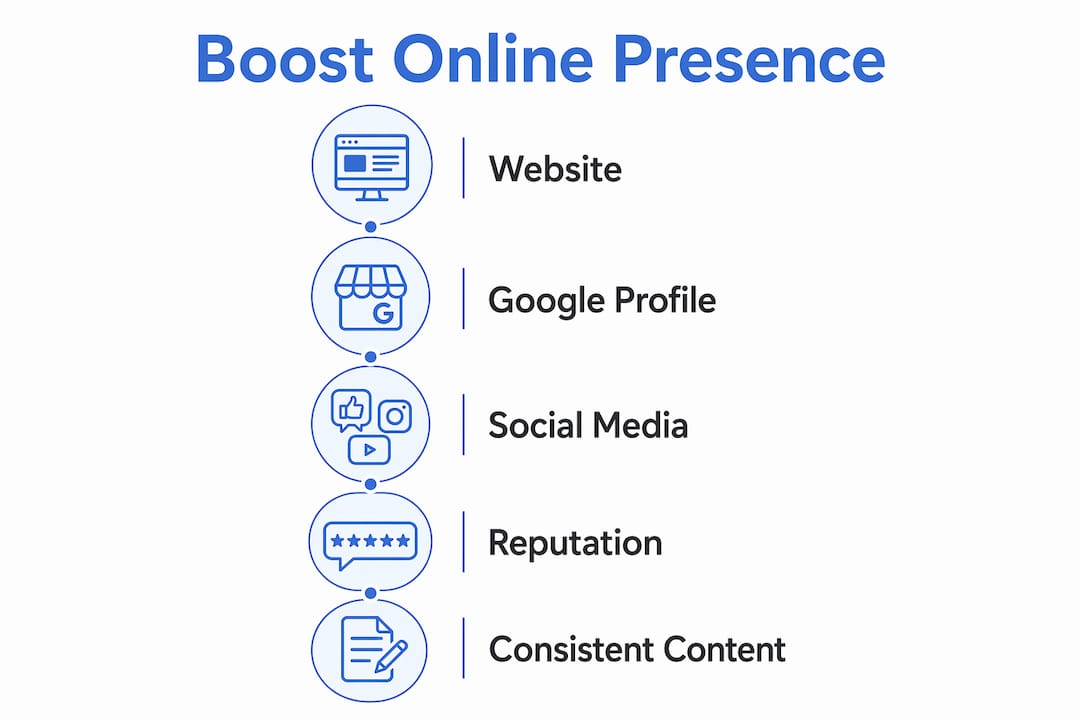
A school’s digital presence is built on four interdependent pillars: a technically sound website, an active Google Business Profile, consistent social media engagement, and systematic reputation management.
| Point | Details |
|---|---|
| Website performance is non-negotiable | Mobile responsiveness and sub-3-second load times directly determine whether parents stay or leave. |
| Google Business Profile drives local visibility | Profiles with 20+ photos and weekly posts see up to 70% higher views in local search results. |
| Brand consistency increases enquiries | Consistent branding across all digital channels increases enrolment enquiries by over 25%. |
| Reputation management is proactive, not reactive | Sending review requests within 48 hours and responding to all feedback builds long-term trust. |
| Technical SEO underpins everything | Schema markup, site architecture, and accessible design determine how search engines rank your school. |
Why I think most schools are getting their digital strategy backwards
Most school leaders I speak with treat their website as a compliance exercise and their social media as an afterthought. They invest in a new website design every five years and then wonder why their enrolment enquiries are flat. The uncomfortable truth is that a beautiful website with poor technical foundations and a neglected Google Business Profile will consistently lose to a plainer site that is fast, mobile-optimised, and actively maintained.
The schools that are genuinely winning in local search in 2026 are not necessarily the ones with the largest marketing budgets. They are the ones that have claimed and actively manage their GBP, post consistently on social media, and have built a website that answers the questions parents are actually asking. That last point matters more than most people realise. SEO-friendly content that answers parent FAQs drives organic discovery over the long term in a way that paid advertising simply cannot replicate.
My other observation is that schools underestimate the compounding effect of consistency. A school that posts three times a week on Facebook, refreshes its GBP photos monthly, and publishes one blog post per month will, within 12 months, have a measurably stronger digital presence than a school that does occasional bursts of activity followed by long silences. The algorithm rewards regularity. So do parents.
The digital engagement tips that actually move the needle are rarely glamorous. They are disciplined, repeatable, and grounded in understanding what parents are searching for. Start there.
— Ed
How Eschools helps schools build a stronger digital presence
If you are a school leader looking to put these strategies into practice without building everything from scratch, Eschools has the tools and expertise to support you. With over 14 years of experience working with UK schools and multi-academy trusts, Eschools designs and manages school websites that drive admissions and parent engagement, built on the technical foundations this guide describes.
From bespoke website design with built-in SEO structure and mobile performance, to communication tools that keep parents informed and engaged, Eschools provides a complete digital platform tailored to the needs of school leaders. You can explore real examples of their work with schools across the UK to see what a well-executed digital presence looks like in practice.
FAQ
What is the most important factor in a school’s online presence?
A technically sound, mobile-responsive website with clear navigation and fast loading speeds is the foundation. Without it, all other digital activity loses much of its impact.
How often should schools post on social media?
Posting 3 to 5 times per week on Facebook and using daily Instagram stories with quality visuals produces the strongest community engagement. Consistency matters more than volume.
How does Google Business Profile affect school enrolment?
Google Business Profile directly influences whether your school appears in the local Map Pack, which captures up to 44% of clicks for education queries. An active, complete profile with regular posts and photos significantly increases visibility and parent enquiries.
How quickly should schools respond to online reviews?
Sending review requests within 48 hours of a positive interaction and responding promptly to all reviews improves both review volume and local search ranking signals.
Do schools need a blog to improve their search rankings?
Schools that publish monthly blog posts answering common parent questions see substantial increases in organic search discovery. A consistent content strategy builds long-term authority that paid advertising cannot replicate.