
TL;DR:
- Efficiency in schools means achieving the best educational outcomes with minimal resource waste. Most schools operate below full efficiency, leaving capacity on the table and missing opportunities to improve quality. Implementing digital workflows, KPIs, and benchmarking helps embed sustainable efficiency that enhances teaching and preserves broad educational programs.
Efficiency in schools is defined as achieving the best possible educational outcomes with the resources available, without unnecessary waste of time, money, or staff effort. A study of 111 public primary schools found that only 20% were fully efficient, with an average efficiency score suggesting a potential 10% reduction in inputs without any loss in output. That figure alone tells you something important: most schools are leaving capacity on the table. Understanding why efficiency matters for schools is not an abstract exercise. It is the difference between a school that thrives under budget pressure and one that struggles to maintain quality. Research across 20 countries confirms that higher spending alone does not improve learning outcomes. Efficient resource allocation does.
How does school efficiency impact resource management?
Operational efficiency is the recognised term for how well a school converts its inputs, such as staff time, budget, and facilities, into measurable outputs like pupil progress and staff wellbeing. When schools operate efficiently, they reduce waste across staffing, procurement, and administration without cutting corners on quality.

Empirical studies show that inefficient schools routinely overspend on processes that deliver little educational value. Manual, labour-intensive tasks such as recording examination grades and managing paper-based communications drain educator time that could be spent on teaching. Automating these workflows does not just save hours. It reduces errors, lowers stress, and frees staff to focus on the work that actually moves pupils forward.
Key Performance Indicator (KPI) frameworks give school leaders a structured way to monitor where resources are going and whether they are producing results. Operational KPIs focus on productivity, resource utilisation, and process performance rather than raw activity counts. That distinction matters enormously. A school that processes 500 parent communications a week is not necessarily efficient. A school that resolves 95% of parent queries within 24 hours is.
Practical areas where operational efficiency delivers measurable resource savings include:
- Staff time allocation: Automating timetabling, attendance tracking, and report generation returns hours to teachers each week.
- Budget management: KPI dashboards flag overspend in real time, allowing leaders to act before costs escalate.
- Facilities use: Tracking room occupancy and equipment usage prevents duplication and unnecessary capital expenditure.
- Communication workflows: Digital messaging platforms replace paper letters, cutting print costs and improving delivery rates.
Pro Tip: Map your school’s top five administrative tasks by time cost before investing in any digital tool. You will quickly identify where automation delivers the fastest return.
What role does efficiency play in improving student outcomes?
Efficiency directly benefits pupils by giving teachers more time to teach. When administrative burdens are reduced, teachers can plan better lessons, provide more individual feedback, and support pupils who are falling behind. The benefits of school efficiency are not confined to the finance office. They reach every classroom.
The relationship between efficiency and learning outcomes follows a clear sequence:
- Reduce administrative load. Automating routine tasks returns instructional time to teachers. Research confirms that manual grading and data entry are among the largest time drains on educators.
- Redirect resources to teaching quality. Savings from efficient operations can fund continuing professional development, smaller group interventions, and better learning materials.
- Monitor outcomes with KPIs. Schools that track pupil progress data alongside operational metrics can identify underperformance early and respond before it becomes entrenched.
- Protect comprehensive programmes. Efficient schools sustain arts, sport, and enrichment activities because they are not haemorrhaging budget on avoidable waste.
- Sustain staff wellbeing. Teachers who are not buried in paperwork are less likely to experience burnout, which directly affects the quality and consistency of teaching.
One critical caution applies here. Excessive focus on test scores as the primary efficiency metric risks stripping away the broader educational programmes that support pupil development. This is known as the dilution effect. A school that cuts music, drama, and physical education to improve its SATs results has not become more efficient. It has narrowed its offer and harmed its pupils. True efficiency in education protects quality. It does not sacrifice it.
What are common misconceptions about efficiency in schools?
The most damaging misconception is that efficiency means cost-cutting. It does not. Efficiency means achieving more with what you have, not doing less with less. School leaders who conflate the two risk making decisions that harm pupils, demoralise staff, and ultimately reduce the school’s effectiveness.
A second widespread error is measuring efficiency by activity volume. Focusing on activity counts rather than outcomes misleads leaders into thinking a busy school is an efficient one. The number of meetings held, letters sent, or reports produced tells you nothing about whether any of it improved pupil progress or staff performance.
Common misconceptions to watch for include:
- Confusing busyness with productivity. High staff workload does not equal high output. Measure outcomes, not effort.
- Treating all budget reductions as efficiency gains. Cutting a teaching assistant post saves money. It does not improve efficiency if pupil support deteriorates as a result.
- Ignoring context. Regional economic disparities affect what efficiency looks like in practice. A school in a deprived area faces different constraints than one in a well-funded authority.
- Using general benchmarks rather than peer comparisons. Comparing your school against a national average obscures performance. Benchmarking by school size reveals far more useful insights.
Pro Tip: Before setting efficiency targets, define what “better outcomes” means for your school specifically. Pupil progress, staff retention, and parent satisfaction are all valid measures. Choose the ones that reflect your school’s priorities.
Which strategies can schools use to embed efficiency sustainably?
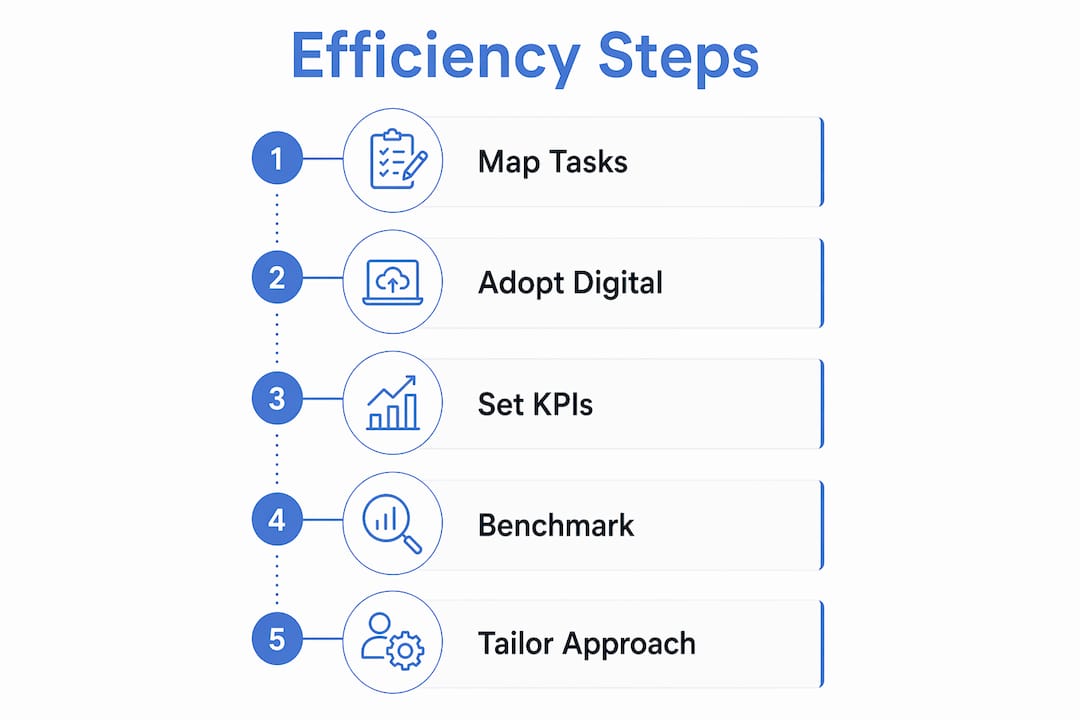
Sustainable efficiency requires a deliberate approach. One-off cost reductions do not build lasting capacity. The schools that improve consistently over time are those that embed efficiency into their culture, systems, and leadership practices.
Adopt digital workflows for administration
School administration software reduces the manual burden on office staff and senior leaders. Digital onboarding, automated communications, and centralised data management all cut the time spent on low-value tasks. The shift from paper-based to digital processes is not simply a technology upgrade. It is a structural change in how a school operates.
Build a KPI framework aligned to your goals
A shared KPI framework gives your leadership team a common language for performance. Effective school KPIs cover three areas: productivity (output per staff member), resource utilisation (budget and time allocation), and process performance (speed and accuracy of key workflows). Proactive KPI monitoring replaces reactive problem-solving with planned improvement.
Benchmark against similar schools
Comparing your performance against schools of a similar size and demographic profile gives you a realistic picture of where you stand. General national averages mask the performance of schools operating in very different contexts. Peer benchmarking identifies genuine high performers and surfaces the practices that drive their results.
Tailor your approach to your context
Economic and regional factors shape what efficiency gains are achievable. Schools in areas with stronger fiscal support can invest in technology and training that generate long-term returns. Schools in constrained environments need to prioritise the highest-impact changes first. A context-sensitive approach prevents leaders from chasing efficiency gains that are not realistic for their setting.
The table below summarises the key strategy areas and their primary benefits:
| Strategy | Primary benefit |
|---|---|
| Digital workflow adoption | Reduces staff time on administration |
| KPI framework implementation | Enables data-driven, proactive decisions |
| Peer benchmarking | Identifies realistic improvement targets |
| Context-sensitive planning | Aligns efficiency goals to local conditions |
| Automation of communications | Cuts costs and improves parent engagement |
For school leaders looking to improve parent communication efficiency, digital tools that centralise messaging and automate routine updates deliver some of the fastest visible gains.
Key takeaways
Efficiency in schools is the single most reliable way to protect educational quality under budget pressure, and it requires outcome-focused measurement, not activity counts or cost reductions alone.
| Point | Details |
|---|---|
| Efficiency is not cost-cutting | True efficiency improves outcomes with existing resources, not by reducing quality. |
| KPIs must measure outcomes | Track productivity, resource use, and process performance rather than activity volume. |
| Automation frees teaching time | Digital workflows reduce administrative burden and return hours to classroom instruction. |
| Benchmarking by peer group works | Comparing schools of similar size reveals more useful insights than national averages. |
| Context shapes what is achievable | Regional and economic factors must inform efficiency targets and investment decisions. |
The case for treating efficiency as a leadership priority
School efficiency is one of those topics that gets discussed in budget meetings and then quietly shelved when the pressure eases. I have seen this pattern repeatedly, and it frustrates me, because the schools that treat efficiency as a permanent leadership priority are the ones that consistently outperform their peers on outcomes that actually matter.
What I find most telling is the gap between how school leaders talk about efficiency and how they measure it. Most track spending. Very few track the cost of staff time lost to avoidable administrative tasks, or the opportunity cost of a teacher spending two hours a week on manual data entry instead of lesson planning. That is where the real inefficiency lives, and it is largely invisible until you build the right KPIs to surface it.
The dilution effect is a genuine risk that does not get enough attention. When efficiency becomes synonymous with cutting programmes, schools lose the very things that make them worth attending. The arts, sport, and enrichment activities are not luxuries. They are part of what keeps pupils engaged and staff motivated. Protecting them is an efficiency decision, not a spending one.
My honest view is that data-driven school leadership is no longer optional. The schools that will thrive over the next decade are those that build operational intelligence into their culture now, not as a response to crisis, but as a standard way of working.
— Ed
How Eschools supports school efficiency in practice
School leaders who want to move from theory to practice need tools that fit the way schools actually work.

Eschools has supported UK schools and multi-academy trusts for over 14 years with digital solutions designed to reduce administrative overhead and improve engagement. From bespoke school websites that drive admissions and parent communication, to parents’ evening booking tools that eliminate scheduling bottlenecks, every product is built around the operational realities of school life. The Eschools platform also supports MAT leaders with centralised management tools that make trust-wide efficiency visible and measurable. You can see the full range of solutions and how schools have used them at Eschools’ work portfolio.
FAQ
What does efficiency mean in a school context?
Efficiency in schools means achieving the best possible educational outcomes using available resources, without wasting staff time, budget, or effort. It is measured through outcome-focused KPIs rather than activity counts.
Does spending more money make a school more efficient?
No. Research across 20 countries shows that higher public expenditure does not automatically improve learning outcomes. Efficient resource allocation matters more than spending volume.
What is the dilution effect in school efficiency?
The dilution effect occurs when schools focus so heavily on measurable metrics like test scores that they cut broader programmes such as arts or sport. This narrows the educational offer and ultimately harms pupil development.
How should schools measure operational efficiency?
Schools should use KPI frameworks that track productivity, resource utilisation, and process performance. Benchmarking against schools of a similar size provides more accurate comparisons than general national averages.
How does automation improve school efficiency?
Automating manual tasks such as attendance recording, grade entry, and parent communications frees staff time for teaching and reduces errors. Research confirms that administrative burden is one of the leading causes of educator burnout.